

Best Wooden Stacking Toys for Toddlers 2026
Table of Contents
- Why Wooden Stacking Toys Belong in Every Toddler's Playroom
- How to Choose Safe Wooden Toys: What Parents Should Check
- Best Wooden Stacking Toys for Toddlers: Our Top Picks
- Matching Stacking Toys to Your Toddler's Developmental Stage
- Open-Ended Play vs. Structured Play: Which Approach Wins?
- Cleaning, Maintenance and DIY Storage for Wooden Toys
- Which Wooden Stacking Toy Should You Buy?
- Conclusion
Last Updated: August 15, 2026
Wooden stacking toys have been a cornerstone of early childhood learning for generations. At Lulliyotoys, we've curated a collection of premium, Montessori-inspired toys designed to support the early development of babies, infants, and toddlers.
Quick Picks:
- Best Budget Pick: Wooden Animal Balance Stacking Toy Montessori Game ($20), screen-free fun that builds focus and fine motor skills
- Best for Shape Learning: Montessori Wooden Bear Shape Sorting & Stacking Toy ($25), introduces early maths concepts through play
- Best Sensory Option: Wooden Rainbow Animal Stacking Toy ($33), bright colours and animal shapes for colour and form recognition
- Best for Balance Play: Wooden Animal Balance Blocks ($35), patience-building challenge for ages 4-6
- Best Creative Builder: Montessori Wooden Rainbow Blocks 12-Piece Arch Set ($42), open-ended building with 12 arch pieces
- Best Premium Set: Wooden Montessori Train Set ($60), imaginative play with farm accessories and track building
Why Wooden Stacking Toys Belong in Every Toddler's Playroom
Wooden stacking toys are among the most developmentally efficient toys available for children under five. Unlike battery-powered toys that do the work for the child, wooden stacking toys require active participation, precisely where the developmental benefit lies. According to Australian Institute of Family Studies research on early childhood play, hands-on, open-ended play in the early years is directly linked to stronger cognitive outcomes in primary school. The natural tactile experience of smooth wood, the weight of each piece, and the visual feedback of a tumbling tower engage a toddler's developing brain in ways plastic alternatives cannot replicate.

Fine Motor Skills and Hand-Eye Coordination
Fine motor skill development happens through every attempt to place one piece on top of another. The grasping reflex that babies are born with gradually refines into deliberate, precise finger control. Hand-eye coordination develops as toddlers visually track each piece and adjust their hand movements accordingly. Chunky blocks with varied geometric shapes require children to rotate, orient, and position each piece, building spatial reasoning that underpins later mathematical thinking.
Cognitive Development, Problem-Solving and Spatial Awareness
Problem-solving begins the moment a toddler tries to balance one piece on another and fails. This renewed determination is cognitive development in its most visible form. Spatial awareness grows as children understand that a larger piece cannot balance on a smaller one, that curved surfaces behave differently from flat ones, and that the order of stacking matters. Sorting and threading activities built into multi-function stacking sets add colour recognition and sequencing, gently introducing basic mathematical concepts before formal education begins.
How to Choose Safe Wooden Toys: What Parents Should Check
Knowing what to look for on a label or product page makes the difference between a toy that genuinely supports development and one that merely looks the part.
Safety Standards and Child-Safe Finishes
Toy safety in Australia is governed by mandatory standards under the Australian Competition and Consumer Commission toy safety requirements, specifically the mandatory standard for toys for children up to and including 36 months. For finishes, look for water-based paint, which contains significantly lower levels of volatile organic compounds than solvent-based alternatives. Smooth edges are equally important, run your finger along every edge and corner before handing any wooden toy to a toddler.
Sustainability and Eco-Certification
FSC certification (Forest Stewardship Council) is the most recognised international standard for responsibly sourced timber. Look for explicit certification marks rather than vague language like "natural" or "eco-friendly." Sustainable forestry certification combined with water-based paint and non-toxic finishes represents the full picture of an environmentally responsible wooden toy. Heirloom quality, durable construction that lasts through multiple children, is inherently more sustainable than cheaper toys replaced frequently.
Best Wooden Stacking Toys for Toddlers: Our Top Picks
The six wooden stacking toys below represent the strongest options across different budgets, age ranges, and developmental priorities.
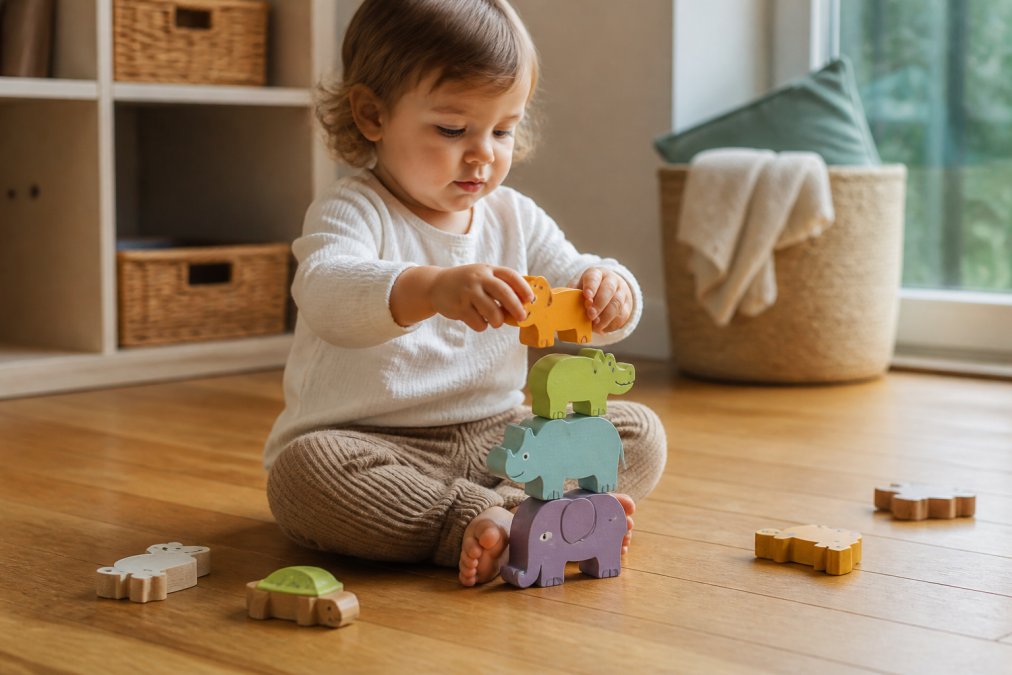
1. Wooden Animal Balance Stacking Toy Montessori Game - $20
This entry-level set delivers genuine developmental value at an accessible price. The dinosaur-themed animal pieces are designed to be balanced one on top of another, introducing the physics of balance and stability in a context toddlers find exciting.
Best for: Toddlers aged 18 months and up ready for their first real stacking challenge.
The colourful animal designs spark imaginative play naturally. Children don't just stack, they create stories.
Pros:
- Accessible price point for a first stacking toy
- Encourages imaginative play alongside fine motor development
- Suitable for independent play or parent-child activity time
Cons:
- Simpler challenge level compared to higher-tier sets
- Best suited to younger toddlers rather than children approaching school age
Shop the Wooden Animal Balance Stacking Toy Montessori Game at Lulliyotoys
2. Montessori Wooden Bear Shape Sorting & Stacking Toy - $25
Shape sorting and stacking in one toy is a smart combination. The geometric pieces require children to match shapes and colours before stacking, adding cognitive challenge that pure stacking toys don't offer.
Best for: Toddlers aged 12-24 months working on shape and colour recognition alongside fine motor development.
Sorting activities gently introduce sequencing and early mathematical concepts without formal instruction. The sturdy natural wood and smooth edges make this one of the safer options for children who still explore with their mouths.
Pros:
- Combines shape sorting with stacking for dual developmental benefit
- Introduces early maths skills through play
- Safe wooden construction with water-based paint
Cons:
- Shape matching can frustrate younger toddlers still developing spatial awareness
Shop the Montessori Wooden Bear Shape Sorting & Stacking Toy at Lulliyotoys
3. Wooden Rainbow Animal Stacking Toy - $33
Bright rainbow hues and animal shapes make this one of the most visually engaging wooden stacking toys. The colour recognition element is built directly into play, children naturally begin sorting by colour before being taught to, which is exactly the kind of self-directed learning Montessori-inspired play encourages.
Best for: Toddlers aged 18 months and up, particularly strong for children who respond well to colour and visual stimulation.
The animal shapes add a form-recognition dimension that chunky blocks alone cannot provide.
Pros:
- Exceptional visual appeal encourages sustained engagement
- Supports colour recognition, shape recognition, and fine motor skills simultaneously
- Durable construction suitable for home and classroom use
Cons:
- Mid-range price bracket
- Children who've outgrown basic stacking may find it less challenging
Shop the Wooden Rainbow Animal Stacking Toy at Lulliyotoys

4. Wooden Animal Balance Blocks - $35
This is where stacking becomes genuinely challenging. Each piece must be placed carefully to maintain the overall structure, demanding concentration and motor planning that younger toddlers aren't ready for. The product is recommended for children aged 4-6 years, and that age guidance is accurate.
Best for: Older toddlers and preschoolers who've mastered basic stacking and need a more demanding challenge.
The Montessori-inspired open-ended design means there's no single correct way to play. Children can attempt to build the tallest tower, recreate specific animal arrangements, or invent their own games entirely.
Pros:
- Higher difficulty level extends the toy's useful lifespan
- Open-ended design supports imaginative play and creative expression
- Builds patience, concentration, and problem-solving through genuine challenge
Cons:
- Not suitable for toddlers under 3 years
- The balance challenge may require adult guidance initially
Shop the Wooden Animal Balance Blocks at Lulliyotoys

5. Montessori Wooden Rainbow Blocks 12-Piece Arch Set - $42
The 12-piece arch set is the most versatile creative building toy in this list. The arch shape opens up construction possibilities that rectangular blocks cannot, children can build tunnels, bridges, enclosures, and abstract structures, developing spatial reasoning in genuinely different ways.
Best for: Children aged 2 and up ready for open-ended creative building rather than prescribed stacking sequences.
The rainbow colour progression naturally introduces colour ordering and gradient concepts. According to Early Childhood Australia's position statement on play-based learning, open-ended play materials that can be used in multiple ways produce stronger developmental outcomes than single-function toys.
Pros:
- 12 pieces offer significantly more creative scope than smaller sets
- Arch shape enables unique building configurations
- Bright rainbow colours support colour recognition and visual tracking
Cons:
- Higher price point requires deliberate purchasing decision
- Smaller arch pieces may challenge children with less-developed fine motor skills
Shop the Montessori Wooden Rainbow Blocks 12-Piece Arch Set at Lulliyotoys
6. Wooden Montessori Train Set - $60
The premium option takes a different approach to development. Rather than pure stacking, the train set introduces cooperative social play, storytelling, and imaginative play through a farm-themed railway layout with animals, bridges, and colourful track pieces.
Best for: Toddlers aged 2 and up, particularly strong for children ready for more complex narrative play.
Fine motor skills and hand-eye coordination remain central, building the track requires precision, and connecting train carriages demands careful manipulation. The real developmental value lies in storytelling and language development.
Pros:
- Supports fine motor skills, cooperative play, and imaginative storytelling simultaneously
- Non-toxic wood and durable construction built for long-term use
- Open-ended farm accessories extend play possibilities significantly
Cons:
- Higher price point positions this as a considered gift
- Less focused on pure stacking development than other sets
Shop the Wooden Montessori Train Set at Lulliyotoys
Matching Stacking Toys to Your Toddler's Developmental Stage
The biggest mistake parents make is choosing by age label alone. Developmental readiness matters far more than chronological age.
| Age Range | Developmental Focus | Recommended Toy | Key Skill Targeted |
|---|---|---|---|
| 12-18 months | Grasping reflex, basic stacking | Bear Shape Sorting & Stacking ($25) | Shape and colour recognition |
| 18-24 months | Hand-eye coordination, colour | Rainbow Animal Stacking Toy ($33) | Visual tracking, fine motor skills |
| 18-30 months | Balance, focus, imaginative play | Animal Balance Stacking Game ($20) | Motor planning, concentration |
| 2-4 years | Creative building, spatial reasoning | Rainbow Arch Blocks 12-Piece ($42) | Spatial awareness, open-ended play |
| 2-4 years | Narrative play, social development | Montessori Train Set ($60) | Cooperative play, storytelling |
| 4-6 years | Precision, patience, problem-solving | Animal Balance Blocks ($35) | Balance, fine motor precision |
Watch for consistent frustration without successful moments, the toy is likely too advanced. If a child completes every challenge within the first session with no interest in returning, they've probably outgrown it.
Open-Ended Play vs. Structured Play: Which Approach Wins?
Open-ended play, where there is no single correct outcome, produces stronger gains in creative expression, problem-solving, and cognitive flexibility. A set of wooden stacking blocks with no prescribed configuration forces a child to generate their own goals, test hypotheses, and evaluate results, a cognitively richer process than following predetermined sequences. Structured play has its place in teaching specific concepts, but the best approach combines both types across different play sessions.
Cleaning, Maintenance and DIY Storage for Wooden Toys
Wooden toys last longer than almost any other material, but only with appropriate care.
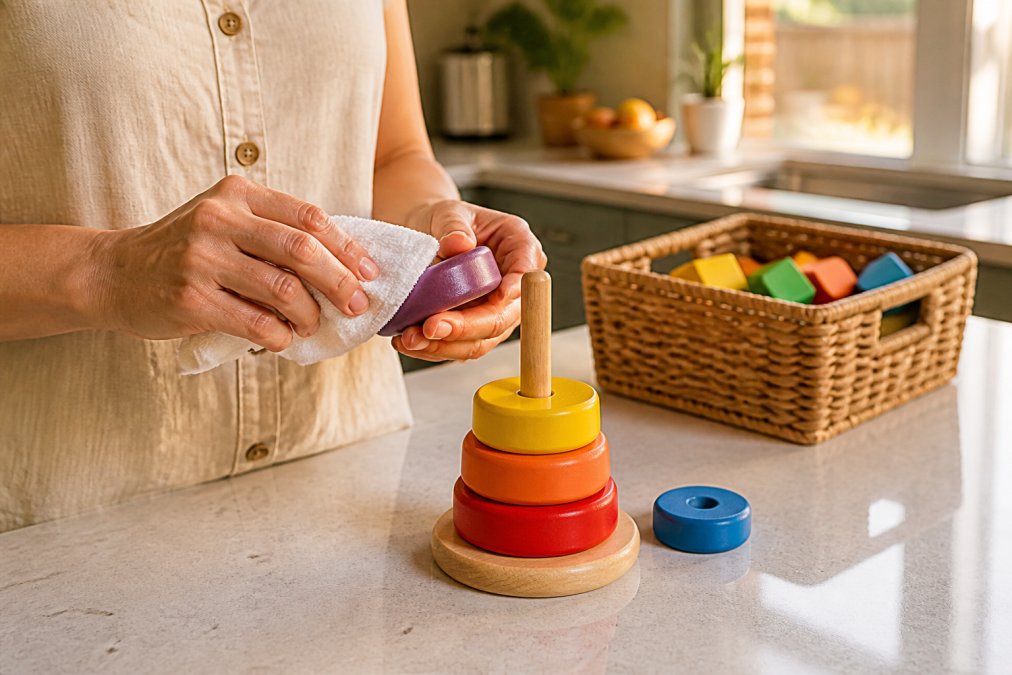
Cleaning wooden stacking toys correctly:
- Wipe surfaces with a slightly damp cloth; never submerge in water or use a dishwasher
- For stubborn marks, use mild soap on a damp cloth; wipe dry immediately
- Avoid alcohol-based wipes or harsh chemical cleaners, which strip water-based paint finishes
- Allow toys to air dry completely before storing
Maintaining the wood over time:
A light application of food-grade beeswax or coconut oil every few months keeps natural wood from drying out and cracking. Apply with a soft cloth, let it absorb for 30 minutes, then buff off excess.
DIY storage solutions that actually work:
- Shallow wicker baskets sorted by toy type, allowing children to see and access pieces independently
- Open shelving at toddler height, following the Montessori shelf principle: fewer toys visible at once, rotated regularly
- Small canvas drawstring bags for individual sets, kept on a low shelf or hook
- A repurposed wooden crate divided with cardboard into sections for different piece sizes
Toy rotation is underrated as a strategy. Cycling toys in and out of storage every two to three weeks maintains novelty, the single most effective way to prevent a quality toy from ending up in the donation pile.
Which Wooden Stacking Toy Should You Buy?
The right choice depends on your child's current developmental stage, the primary skill you want to support, and your budget.
For children under 18 months, the Bear Shape Sorting & Stacking Toy at $25 is the strongest starting point. For toddlers between 18 months and 3 years, the Rainbow Animal Stacking Toy at $33 and the Animal Balance Stacking Game at $20 both deliver strong value. For children approaching preschool age, the 12-Piece Arch Set at $42 offers open-ended creative building possibilities that grow with the child. The Train Set at $60 is the right investment when a child has moved beyond stacking and is ready for narrative, cooperative play. The Animal Balance Blocks at $35 are best reserved for children aged 4 and up who need a genuine precision challenge.
| Toy | Price | Best Age | Primary Skill |
|---|---|---|---|
| Animal Balance Stacking Game | $20 | 18 months+ | Focus, fine motor skills |
| Bear Shape Sorting & Stacking | $25 | 12-24 months | Shape and colour recognition |
| Rainbow Animal Stacking Toy | $33 | 18 months+ | Colour recognition, visual tracking |
| Animal Balance Blocks | $35 | 4-6 years | Balance, precision, patience |
| Rainbow Arch Blocks 12-Piece | $42 | 2 years+ | Spatial reasoning, creative building |
| Wooden Montessori Train Set | $60 | 2 years+ | Imaginative play, social development |
As noted in Raising Children Network's guide to toys and play for toddlers, the best toy for any child is one that matches their current abilities closely enough to be achievable but challenges them just enough to require effort.
Choosing the right wooden stacking toy is one of the highest-impact decisions you can make for a toddler's early development. The range at Lulliyotoys is designed to support every stage of that progression. From the entry-level balance game at $20 to the premium train set at $60, each toy is built around Montessori-inspired principles, safe non-toxic materials, and durable construction that holds up to years of play. Explore the full Lulliyotoys wooden stacking toy collection and find the right match for where your child is right now.
Frequently Asked Questions
Are wooden stacking toys safe for 1-year-olds?
Wooden stacking toys can be safe for 1-year-olds provided they meet Australian toy safety standard AS/NZS 8124. Check that pieces are large enough to avoid choking hazards (no component smaller than 45 mm), edges are smooth, and finishes are water-based and non-toxic. Chunky blocks designed for babies and infants are the safest choice at this age. Always supervise play and check for splinters or loose parts before each session.
What are the developmental benefits of wooden stacking toys?
Wooden stacking toys support several developmental milestones at once. Physically, they build fine motor skills, grip strength, and hand-eye coordination as children grasp and place each piece. Cognitively, sorting by colour, size, or shape develops problem-solving, spatial awareness, and early mathematical thinking. Open-ended play also encourages creative expression and imaginative play. The tactile experience of natural wood adds a sensory dimension that plastic alternatives rarely match.
How do I choose the right stacking toy for my toddler's age?
Match the toy's complexity to your child's current motor planning ability. Under 18 months: large chunky blocks with simple stacking only. Ages 18 months to 3 years: shape sorting and nesting bowls that introduce geometric shapes and colour recognition. Ages 3 to 5 years: balance stacking games and arch sets that demand more precise hand-eye coordination and problem-solving. When in doubt, choose a toy that challenges your child slightly beyond their current skill level to keep engagement high.
What makes wooden stacking toys better than plastic alternatives?
Natural wood offers a richer tactile experience and genuine weight, which helps toddlers develop motor planning and the grasping reflex more effectively than lightweight plastic. Durable construction means a quality wooden set typically outlasts multiple plastic equivalents, making it better value over time. Sustainably sourced wooden toys also carry a lower environmental footprint. From a safety perspective, solid wood with water-based paint is less likely to contain the plasticisers sometimes found in cheaper plastic toys.
Are Montessori stacking toys worth the investment compared to cheaper alternatives?
Montessori-inspired wooden stacking toys are designed for open-ended play, meaning a single set can engage a child across multiple developmental stages rather than becoming redundant quickly. The heirloom quality of well-made wooden toys also means they can be passed to younger siblings. While the upfront cost is higher than mass-market plastic options, the longevity, educational value, and safety profile of non-toxic, child-safe finishes generally justify the price difference for parents focused on early childhood learning.
This article was written using GrandRanker