

How to Choose Non-Toxic Baby Toys: A 2026 Guide
Table of Contents
- Why Non-Toxic Baby Toys Matter More Than Most Parents Realise
- Safe Materials for Baby Toys: What to Choose and What to Avoid
- Australian Toy Safety Standards AS/NZS ISO 8124 Explained
- Step-by-Step: How to Choose Non-Toxic Baby Toys at Any Price Point
- How to Clean Wooden Baby Toys Safely
- Buying Second-Hand and Budget-Friendly DIY Alternatives
- Sensory Development, Play-Based Learning, and Material Safety
- Recycling and End-of-Life Disposal of Baby Toys
Last Updated: August 16, 2026
Why Non-Toxic Baby Toys Matter More Than Most Parents Realise
Most parents check for choking hazards but overlook what happens when toys are mouthed, chewed, or left in warm rooms. Non-toxic baby toys matter because infants spend significant waking hours in direct contact with toy materials, and chemical exposures can accumulate over time.
At Lulliyotoys, we hear this constantly: "Are these actually safe, or is 'non-toxic' just marketing?" The honest answer is that not all toys marketed as safe are equal. The gap between genuinely non-toxic products and those meeting minimum import requirements is wider than most expect.
Here's what most guides miss: they focus on what to avoid without giving parents a practical framework for evaluating any toy. Below, we cover materials, certifications, and real-world checks that matter, including things even well-researched parents tend to miss.
The stakes are real. Babies are physiologically more vulnerable to chemical exposures than adults. Their bodies absorb substances at higher rates relative to body weight, and their developing neurological and endocrine systems are sensitive to disruption from phthalates, heavy metals, and volatile organic compounds. According to Australian Institute of Health and Welfare guidance on environmental health, early-life chemical exposures are a recognised area of concern for child health outcomes.
This guide covers safe and unsafe materials, how to read certifications, off-gassing, cleaning, second-hand buying, and what sensory development requires from a material safety perspective.
Safe Materials for Baby Toys: What to Choose and What to Avoid
The single most useful step is identifying a toy's primary material and asking: has this material been independently tested for compounds that matter?
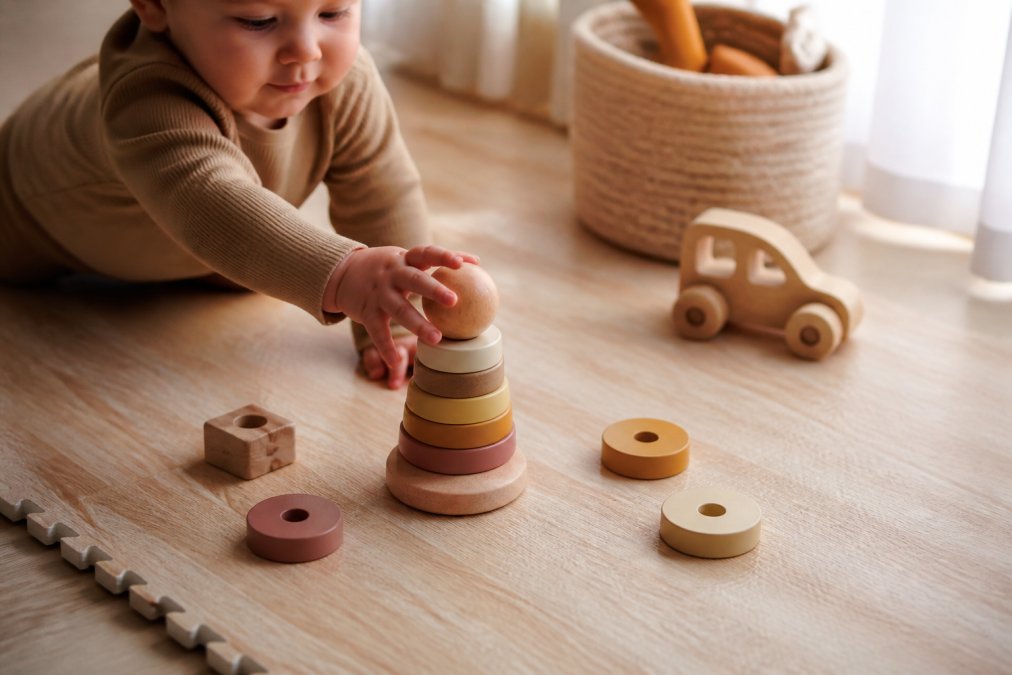
Materials That Are Safe: Wood, Organic Cotton, and Natural Rubber
Sustainably sourced wood is one of the oldest and most reliable toy materials. Solid hardwood toys finished with beeswax, natural oils, or water-based stains are non-porous, durable, and free from chemical additives found in plastics. Look for FSC certification, confirming sustainable forestry. Formaldehyde-free glues matter too; cheaper wooden toys sometimes use MDF bonded with urea-formaldehyde resins.
Organic cotton is the standard for soft toys and cloth books. Conventional cotton is chemically intensive, and pesticide residues can persist in finished fabrics. GOTS-certified organic cotton is grown without synthetic pesticides and processed without harmful finishes. For babies who chew fabric toys, this distinction is meaningful.
Natural rubber is excellent for teethers and soft toys, biodegradable, hypoallergenic, and free from plasticisers. Confirm it is 100% natural rubber, not a blend.
Food-grade silicone is synthetic but widely considered safe for infant use when properly formulated. BPA-free and phthalate-free silicone teethers, like the Silicone Baby Stacking Blocks from Lulliyotoys, meet the standard most parents seek: soft enough for teething, easy to clean, and free from problematic chemical additives.

Materials to Avoid: PVC, BPA, Phthalates, and Heavy Metals
Polyvinyl chloride (PVC) is inherently rigid, so manufacturers add phthalates to make it flexible. Phthalates are endocrine disruptors that interfere with hormone signalling. Soft, flexible plastic toys are frequently made from PVC. If a toy is soft plastic without PVC-free labelling, assume it contains phthalates.
BPA (bisphenol A) is a hardening agent in polycarbonate plastics. While many manufacturers now produce BPA-free products, replacement compounds like BPS and BPF are increasingly under scrutiny for similar hormonal effects.
Lead-based paint and heavy metals remain a concern in toys without rigorous third-party testing. Bright painted surfaces on cheap toys, particularly imports without independent certification, have been found to contain lead and cadmium exceeding safe limits.
Flame retardants added to foam-filled toys are often persistent organic pollutants. Check whether foam components have been treated with chemical flame retardants.
| Material | Safety Status | What to Look For |
|---|---|---|
| Sustainably sourced hardwood | Safe | FSC cert, beeswax or water-based finish, formaldehyde-free |
| Organic cotton | Safe | GOTS certification, no synthetic dyes |
| Natural rubber | Safe | 100% natural, not blended |
| Food-grade silicone | Safe | BPA-free, phthalate-free, food-grade labelled |
| PVC (soft plastic) | Avoid | Contains phthalates; common in squeeze toys |
| Polycarbonate plastic | Caution | Check for BPA-free; BPS/BPF substitutes also concerning |
| Painted surfaces (untested) | Caution | Risk of lead-based paint and heavy metals |
| Foam with flame retardants | Avoid | Persistent chemical additives |
Australian Toy Safety Standards AS/NZS ISO 8124 Explained
Australian toy safety standards are governed by AS/NZS ISO 8124, aligned with the international ISO 8124 framework and administered through Standards Australia. These standards cover physical and mechanical safety, flammability, and specific migration limits for heavy metals including lead, cadmium, antimony, arsenic, barium, chromium, mercury, and selenium.
Compliance with AS/NZS ISO 8124 is mandatory for toys sold in Australia, enforced by the Australian Competition and Consumer Commission (ACCC). The ACCC maintains a product safety database and issues recalls for non-compliant toys. Check the ACCC product safety recall database to verify whether a toy has been recalled.
AS/NZS ISO 8124 does not comprehensively cover all chemical additives, phthalates, BPA, and VOCs from finishes are addressed to varying degrees. Third-party testing fills this gap.
Third-Party Testing and What Certifications Actually Mean
Third-party testing means an independent laboratory, not the manufacturer, has tested the toy against defined criteria. This is the difference between a brand claiming safety and proving it with documented results.
Certifications worth recognising:
- EN 71 (European toy safety standard, Parts 1-3): Widely recognised, includes chemical safety testing for heavy metals and organic compounds. Many Australian-sold toys carry EN 71 certification.
- GOTS (Global Organic Textile Standard): Covers organic cotton and textile components, including fibre origin and processing chemicals.
- FSC (Forest Stewardship Council): Confirms sustainable wood sourcing, not chemical safety.
Material transparency is a stronger signal than marketing claims.
Step-by-Step: How to Choose Non-Toxic Baby Toys at Any Price Point
Step 1: Identify the primary material. Determine what the toy is made from. Unclear material specifications are a red flag.
Step 2: Check for third-party certification. Look for EN 71, GOTS, or FSC. Absence of certification doesn't guarantee unsafety, but means relying on the manufacturer's word alone.
Step 3: Research brand transparency. Does the brand publish test reports? Do they name suppliers? Brands sourcing sustainably tend to be open about it.
Step 4: Check the ACCC recall database. Takes 30 seconds and confirms the product hasn't been flagged.
Step 5: Apply physical checks (finishes, paints, off-gassing).
Step 6: Match the toy to developmental stage. Developmentally appropriate toys get used consistently, keeping safe toys in rotation.
Checking Finishes, Paints, and Dyes Before You Buy
Water-based stains and beeswax finishes are the gold standard. Oil-based paints and lacquers can contain VOCs and heavy metals. Bright painted surfaces on cheap wooden toys are highest-risk.
Look for: "water-based paint," "food-safe finish," "beeswax polish," or "natural oil finish." Be sceptical of "non-toxic paint" without specification or no mention of finish type.
For fabric toys, synthetic dyes are the concern. Azo dyes can break down to release aromatic amines, some carcinogenic. GOTS-certified textiles prohibit harmful azo dyes. Vibrantly coloured soft toys without textile certification have unknown dye sources.
Off-Gassing and VOCs: A Quick Sniff Test and What It Signals
Off-gassing is the release of volatile organic compounds from materials at room temperature. New plastic toys, foam, and painted surfaces off-gas when unpacked. The smell is the signal.
Open the toy packaging and smell it before giving it to your child. A strong chemical, plasticky, or solvent-like smell indicates active off-gassing. Leaving the toy in a well-ventilated space for 24-48 hours before use is a reasonable precaution.
Natural materials off-gas too, fresh wood has a natural scent, but compounds released are typically benign compared to synthetic VOCs.
How to Clean Wooden Baby Toys Safely
Cleaning wooden baby toys safely means avoiding excess moisture and harsh chemical cleaners.
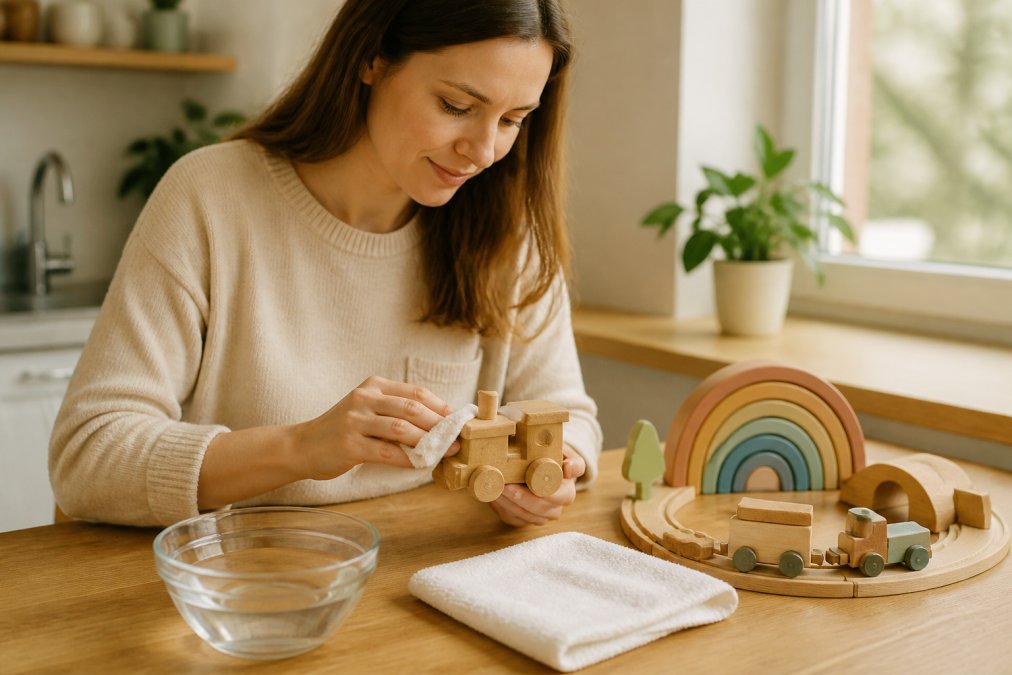
Dampen a clean cloth with water, not soaking wet, and wipe the surface. For stubborn residue, use mild, fragrance-free soap on the cloth. Wipe off soap residue with a second damp cloth, then dry immediately. Never submerge wooden toys or put them in a dishwasher.
Avoid antibacterial sprays, bleach, and alcohol-based sanitisers; these strip finishes, dry wood, and leave chemical residues on surfaces that go into a baby's mouth.
For periodic conditioning, apply beeswax or food-grade mineral oil to keep wood from drying and cracking. Wooden toys are naturally antimicrobial, research shows certain hardwoods inhibit bacterial growth, an advantage over porous foam or fabric toys.
Buying Second-Hand and Budget-Friendly DIY Alternatives
Second-hand wooden toys are worth pursuing with specific caveats. A solid hardwood toy from a reputable brand, purchased second-hand, is often safer than a new cheap plastic toy. The wood has already off-gassed, and material quality is known.
When buying second-hand:
- Inspect painted surfaces for chipping or peeling. Flaking paint is an ingestion risk.
- Check for cracks or splinters. Deep cracks harbour bacteria and create sharp edges.
- Avoid second-hand soft toys unless you can wash them at 60°C.
- Research the original brand. Toys from brands known for EN 71 compliance are safer bets.
- Avoid painted toys made before 2011, when Australian regulations on lead in decorative paints tightened.
For budget-friendly DIY alternatives, untreated hardwood blocks (sanded smooth) make excellent stacking toys. Natural cotton scarves in solid colours work as sensory materials. Sealed glass jars with objects inside create simple sound toys. DIY toys for infants must be free of small parts, sharp edges, and any finish not confirmed food-safe.
Sensory Development, Play-Based Learning, and Material Safety
Sensory development in infants depends on tactile variety. Babies need different textures, weights, temperatures, and resistances to build neural pathways supporting fine motor skills and spatial awareness. This is the basis of Montessori and evidence-based early childhood frameworks.
Materials delivering the richest tactile experience are natural ones. Wood has weight and temperature variation plastic cannot replicate. Natural rubber has give and resistance differing from silicone. Organic cotton has softness and breathability synthetic fabrics lack. The sensory case for natural, non-toxic materials aligns directly with the safety case.
The Lulliyotoys approach combines tactile engagement supporting early development with food-grade silicone construction, giving parents material safety without sacrificing sensory variety. Products like the Soft Silicone Baby Building Blocks & Sensory Balls exemplify this balance.

Safe, natural toys often cost more, but fewer, higher-quality toys used consistently deliver better developmental outcomes than large volumes of cheap toys rotated quickly. According to Australian Government's Raising Children Network on play and development, open-ended play materials supporting multiple uses deliver broader developmental benefits than single-function toys.
Recycling and End-of-Life Disposal of Baby Toys
A toy's environmental and safety story doesn't end when your child outgrows it.
Wooden toys are straightforward to dispose of. Solid hardwood toys without synthetic finishes can be composted or sent to general waste and will biodegrade. Painted or lacquered toys should go to general waste. Donating wooden toys in good condition is best.
Natural rubber toys are theoretically biodegradable, but timelines are long and most council composting facilities won't accept them. Donation is preferable to landfill.
Silicone toys are not biodegradable and not accepted in standard recycling. Specialist silicone recyclers exist but aren't widely accessible. The environmental case for silicone is durability, a toy lasting through multiple children is better than cheap plastic discarded after one.
PVC and conventional plastic toys are most problematic at end-of-life. Most aren't recyclable through kerbside collection. Hard plastic toys marked with recycling codes 2, 4, or 5 are more likely accepted than PVC (code 3).
A cradle-to-grave view reinforces the case for natural, sustainably sourced options. The eco-friendly choice at purchase is also the more responsible choice at disposal.
Choosing safe toys is one of the clearest ways to act on early childhood health knowledge, but information required for genuinely informed decisions is scattered across the industry. Lulliyotoys curates its range around standards that matter: sustainably sourced materials, documented non-toxic certification, and Montessori-aligned designs supporting real developmental outcomes. The Baby Crinkle Cloth Book with Teether and the Silicone Highchair Suction Toy are good starting points for building a safe, developmentally rich toy collection. Get started with Lulliyotoys and give your child toys you can trust from the first reach to the last chew.

Frequently Asked Questions
What materials should I avoid in baby toys?
Avoid toys made with polyvinyl chloride (PVC), which often contains phthalates used to soften the plastic. Steer clear of anything with lead-based paint, BPA in hard plastics, synthetic dyes that aren't water-based, and added flame retardants. Heavy metals such as cadmium and antimony can appear in cheap painted toys. When in doubt, look for non-toxic certification and check whether the product has been third-party tested against AS/NZS ISO 8124.
How do I know if a toy meets Australian safety standards?
Look for compliance with AS/NZS ISO 8124, the Australian and New Zealand standard for toy safety. Reputable sellers will state this on packaging or their website. The Australian Competition and Consumer Commission (ACCC) enforces mandatory safety standards for toys sold here, and you can check product recalls on the ACCC Product Safety website. Third-party testing certificates from accredited laboratories provide the strongest evidence that a toy genuinely meets those standards.
Are wooden toys always safer than plastic toys?
Not automatically. Sustainably sourced wood finished with beeswax or water-based, formaldehyde-free stains is among the safest options available. However, wooden toys coated in lead-based paint or sealed with solvent-heavy varnishes carry real risks. Similarly, BPA-free, phthalate-free silicone can be safer than some wood products. The finish and the adhesives matter as much as the base material, so always check what a wooden toy is treated with before handing it to a baby who teethes on everything.
What does 'BPA-free' actually mean for baby toys?
BPA (bisphenol A) is a chemical used to harden certain plastics. It can migrate into a child's mouth during chewing and has been linked to hormonal disruption in research studies. A BPA-free label means that specific compound was not used in manufacture. However, some replacement chemicals such as BPS or BPF raise similar concerns, so BPA-free alone is not a complete safety guarantee. The safest approach is to choose non-toxic baby toys made from natural rubber, organic cotton, or food-grade silicone with full material transparency from the manufacturer.
This article was written using GrandRanker