

Best Montessori Toys for 1 Year Olds: 2026 Guide
Table of Contents
- Benefits of Montessori Toys for 1 Year Olds
- What to Look for When Buying Montessori Toys
- Top Montessori Toys for 1 Year Olds
- How to Set Up a Montessori Play Area at Home
- Montessori Toy Rotation Guide for Toddlers
- Developmental Milestones at 12-18 Months and Toy Mapping
- Conclusion
Last Updated: August 15, 2026
Choosing the right toys for a one-year-old can feel overwhelming. The Lulliyotoys team has curated Montessori-aligned options that invite your toddler to do the work, build skills, and feel satisfaction. This guide covers the best montessori toys for 1 year old children, what to look for when buying, how to set up a play space that supports independent learning, and how to map toys to your child's developmental milestones at 12 to 18 months.
The Montessori approach is built on a simple idea: children learn best through hands-on, self-directed activity with materials that match their current stage of development. For one-year-olds, that means toys that are tactile, open-ended, and sized for small hands.
Benefits of Montessori Toys for 1 Year Olds
Montessori toys support a child's natural developmental drive rather than replacing it with passive entertainment.
Cognitive and Sensory Development
Montessori toys engage multiple senses at once, which is exactly what a one-year-old's brain needs. At this stage, children are building object permanence, learning cause-and-effect relationships, and developing sustained attention. Toys that produce sound when tilted, change shape when stacked, or reveal hidden objects feed this developmental hunger directly.
Tactile exploration is particularly important between 12 and 18 months. Natural materials like wood, silicone, and cotton provide varied textures that plastic cannot replicate. According to Australian Institute of Family Studies research on early childhood development, the quality of sensory stimulation in the first three years of life has lasting effects on neural architecture.
Fine Motor Skills and Gross Motor Skills
Fine motor skill development happens when a toddler grasps a knobbed puzzle piece, transfers a block from one hand to the other, or fits a shape into a corresponding hole. These actions build the pincer grasp and hand-eye coordination that later underpin writing and self-care tasks.
Gross motor skills develop through climbing, pulling to stand, and navigating physical challenges. A Pikler climbing frame gives a one-year-old a safe structure for testing balance and building core strength.
What to Look for When Buying Montessori Toys
Not every wooden toy is a Montessori toy. Here is what actually matters when evaluating a purchase.
Safety Standards and Non-Toxic Materials
Australian safety standards for children's toys fall under Australian Competition and Consumer Commission toy safety mandatory standards, which include requirements for small parts, sharp edges, and toxic substances. When buying wooden toys, look for finishes described as water-based, food-grade, or finished with natural oils like beeswax.
For silicone toys, food-grade silicone is the benchmark. It is free from BPA and phthalates, dishwasher safe, and soft enough that it will not injure a child who falls against it. Always check that the toy complies with Australian Standard AS/NZS 8124, which covers physical and mechanical properties, flammability, and chemical requirements for toys sold here.
Developmental Appropriateness for 12-18 Months
At 12 to 18 months, the sweet spot includes simple shape sorters with three to four shapes, stacking and nesting toys that require size sequencing, cause-and-effect instruments like rainmakers, climbing structures sized for early walkers, and open-ended blocks for free construction. Avoid toys with more than five or six components at this age.
Top Montessori Toys for 1 Year Olds
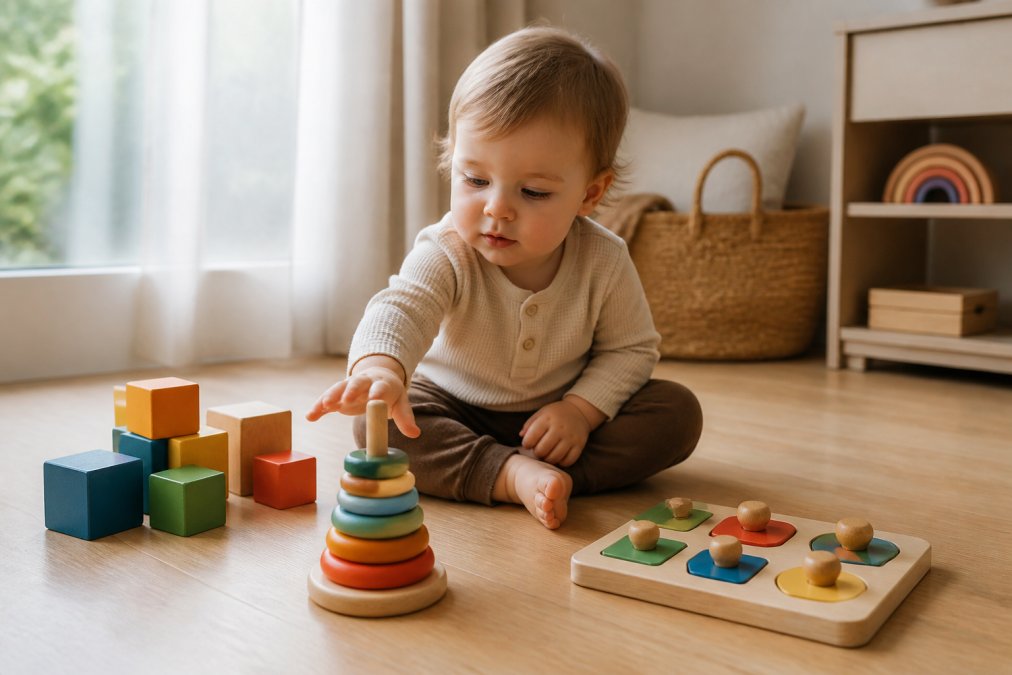
| Toy | Material | Key Skill | Best From |
|---|---|---|---|
| Qtoys Knob Shape Puzzle | Natural wood | Pincer grasp, shape recognition | 12 months |
| Rainbow Nesting Blocks (Qtoys) | Eco-friendly wood | Spatial awareness, sequencing | 12 months |
| Grimm's Large Rainbow | European lime/maple | Open-ended play, creativity | 12 months |
| Muli Stacker Classic | Food-grade silicone | Fine motor, hand-eye coordination | 6 months+ |
| Lil' Learning Cube (B.toys) | Wood composite | Multi-skill engagement | 12 months |
| Mini Rainmaker (Qtoys) | Natural wood | Cause-and-effect, auditory | 6 months+ |
| Natural Blocks in Sack (Wooden Story) | FSC-certified wood | Construction, spatial reasoning | 12 months+ |
| Pikler Climbing Frame (My Happy Helpers) | Birch wood | Gross motor, balance | 6 months-5 years |
1. Knob Shape Puzzle (Qtoys)
The Qtoys Knob Shape Puzzle is the clearest entry point into Montessori-style play for a one-year-old. Three large geometric shapes sit in corresponding recesses, each with a thick wooden knob that a child can grasp. Early on, a child explores the pieces by mouth and hand. Over weeks, they begin matching shapes by trial and error. Eventually, they place pieces correctly with intention. The natural wood finish and smooth sanding make it safe for the mouthing phase.
2. Rainbow Wooden Nesting Blocks (Qtoys)
Size sequencing is one of the first logical operations a toddler performs. The Qtoys Rainbow Wooden Nesting Blocks can be nested inside each other, stacked into towers, or used as containers. A one-year-old stacks and knocks them down. An 18-month-old begins nesting them in order. A two-year-old uses them as furniture for small figures. The same toy supports different developmental stages without modification.
3. Grimm's Large Rainbow
The Grimm's Large Rainbow is probably the most recognised open-ended wooden toy in Montessori circles. Seven arches in graduated sizes and colours can be stacked, nested, stood upright as tunnels, or arranged as a cradle. Made from European lime, maple, alder, and cherry wood, finished with non-toxic water-based glazes and natural oils, it meets a high bar for material safety and tactile quality. For a one-year-old, the immediate appeal is sensory, with spatial awareness developing as a child experiments with how the arches relate to each other.
4. Muli Stacker Classic (Muli Roo)
The Muli Roo Muli Stacker Classic uses food-grade silicone to create a stacking ring toy that is safe for the mouthing phase. The rings are soft, BPA-free, and dishwasher safe. The varying sizes and colours support early size sequencing and colour recognition.
5. Lil' Learning Cube (B.toys)
Five sides of activity on a single portable cube: a shape sorter, bead maze, animal and number tiles, spinning gears, an abacus, and a zig-zag track. It offers genuine value for the range of skills it supports: hand-eye coordination, fine motor control, early counting concepts, and cause-and-effect learning. The wooden construction complies with regulatory requirements for phthalates and BPA.
6. Mini Rainmaker (Qtoys)
The Qtoys Mini Rainmaker is the simplest toy on this list and one of the most effective. Tilt it one way, and the natural materials inside produce a soothing rain-like sound. For a child between six and 18 months, that is a complete cause-and-effect lesson delivered through auditory stimulation. The compact size suits small hands and is safe for mouthing.
7. Natural Blocks in Sack - 100 Pieces (Wooden Story)
One hundred blocks of varying shapes and sizes, sourced from FSC-certified suppliers, finished with beeswax and botanical oils, packed in a thick cotton sack. The price reflects the material quality and longevity of the play. For a one-year-old, introduce a small selection of blocks rather than the full set.
8. Pikler Climbing Frame (My Happy Helpers)
The My Happy Helpers Pikler Climbing Frame gives a toddler a safe, appropriately sized structure for pulling to stand, climbing, and building balance and core strength. Made from birch wood and available in assorted heights, with foldable models for easy storage, it meets Australian and New Zealand standards AS8124: 1, 2, 3, and 6. It remains relevant from six months through to age five or beyond.
How to Set Up a Montessori Play Area at Home
A prepared environment is the physical foundation of Montessori learning at home. Arrange the space so a child can access, use, and return materials independently, without needing an adult to fetch, demonstrate, or manage every interaction.
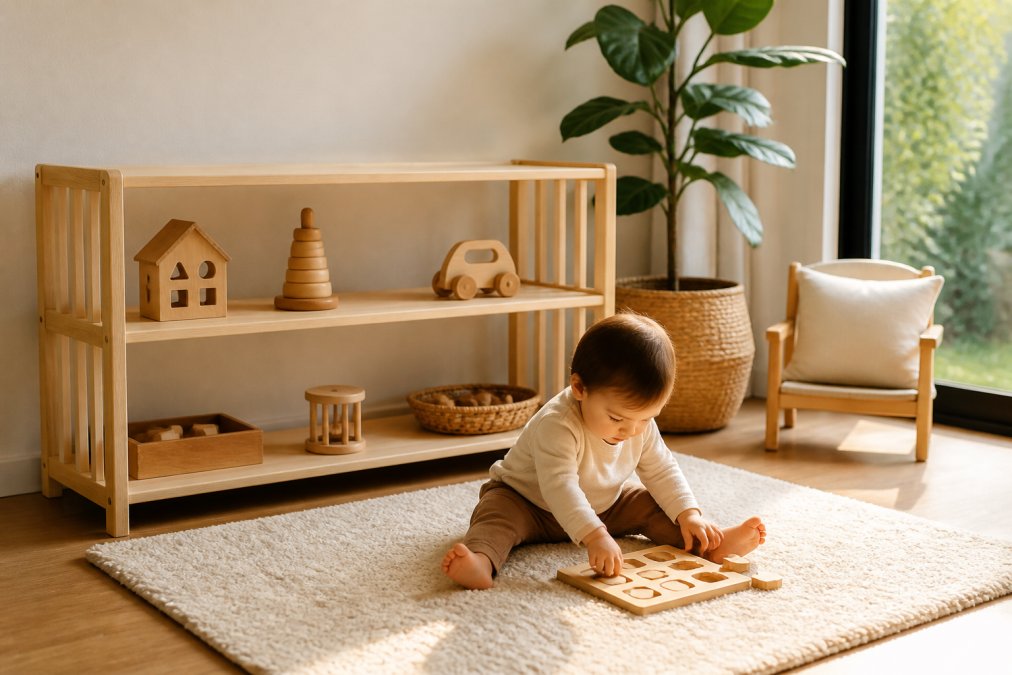
Minimalist Nursery Setup and the Prepared Environment
A minimalist aesthetic is not just a design preference in Montessori thinking; it is a functional choice. Too many toys create visual noise that overwhelms a toddler and reduces engagement quality. The prepared environment principle, drawn from Association Montessori Internationale guidelines on home environments, suggests that fewer, better-chosen materials produce deeper, more sustained play.
Practical setup for a one-year-old: use a low open shelf no higher than 60 centimetres so the child can see and reach all items independently, display three to five toys at a time with space between them, place a soft rug on the floor to define the play area and cushion falls, and keep the lighting natural where possible.
DIY and Household Items That Work as Montessori Toys
One of the most effective Montessori materials for a one-year-old costs nothing. A set of wooden spoons and a metal bowl produces cause-and-effect learning, auditory stimulation, and fine motor practice. A collection of small containers with lids develops grasping, transferring, and early problem-solving. A basket of fabric scraps in different textures supports tactile exploration as effectively as any purchased sensory toy.
Other household items worth repurposing: empty cardboard tubes for rolling, a muffin tin and large pompoms for sorting, a low step stool for climbing, wooden kitchen utensils for grasping, and a small watering can for pouring.
Montessori Toy Rotation Guide for Toddlers
A montessori toy rotation guide is one of the most practical tools a parent can use.
How Many Toys Should a 1 Year Old Have at Once?
Three to five toys on the shelf at any one time is the practical answer for most one-year-olds. The goal is enough variety to offer choice without creating overwhelm. A simple rotation system: divide your toy collection into three groups, display one group on the shelf for two to three weeks, rotate in the next group when engagement drops, and reintroduce earlier toys after a gap. A toy that was ignored three weeks ago often becomes a favourite after a period of absence, reflecting genuine developmental progress.
Cleaning and Maintaining Wooden Toys
Wooden toys require different care from plastic ones. Wipe, do not soak, using a damp cloth with mild soap. Never submerge wooden toys in water; it causes warping and cracking. Dry immediately and allow to air dry fully before returning to the shelf. Sanitise with diluted white vinegar (one part vinegar to one part water). Oil periodically with food-grade mineral oil or beeswax to restore the finish and prevent drying. Sand minor damage with fine-grit sandpaper and re-oil after sanding.
Silicone toys like the Muli Stacker can go in the dishwasher on the top rack.
Developmental Milestones at 12-18 Months and Toy Mapping
Understanding where your child is developmentally helps you choose toys that sit in the productive zone: challenging enough to engage, achievable enough to satisfy. According to Australian Government Raising Children Network developmental milestones for toddlers, children between 12 and 18 months are typically working through a predictable set of physical, cognitive, and social milestones.
| Milestone | What It Looks Like | Toy That Supports It |
|---|---|---|
| Pincer grasp developing | Picks up small objects with thumb and forefinger | Qtoys Knob Shape Puzzle |
| Object permanence established | Searches for hidden objects | Any container-and-lid set |
| Cause-and-effect understanding | Repeats actions to produce same result | Mini Rainmaker |
| Size sequencing beginning | Attempts to nest or stack by size | Nesting Blocks, Grimm's Rainbow |
| Walking and climbing | Pulls to stand, takes steps, attempts low climbs | Pikler Climbing Frame |
| Multi-step play emerging | Combines two or more actions | Natural Blocks, Learning Cube |
| Spatial awareness growing | Explores how objects fit together | Shape Puzzle, Nesting Blocks |
Milestones are ranges, not deadlines. A child who is not yet stacking at 14 months is not behind; they may simply not have had the right material available. Toy mapping is not about accelerating development; it is about providing the right invitation at the right time.
Choosing montessori toys for 1 year old children is easier once you understand the developmental logic behind the selections. The real challenge for most parents is resisting the pull toward more, louder, and busier. At Lulliyotoys, our collection is built around the opposite principle: fewer materials, higher quality, and a clear developmental purpose for every item we stock. Whether you are starting with a single knob puzzle or building a full rotation system, the goal is the same: a space where your child can explore, struggle productively, and discover what they are capable of on their own terms. Browse the Lulliyotoys collection to find curated montessori toys that support your child's development from 12 months and beyond.
Frequently Asked Questions
What age should you start using Montessori toys?
Montessori principles apply from birth. Simple sensory toys such as rattles and grasping rings suit newborns, while cause-and-effect toys, shape sorters, and stacking rings become appropriate from around 6 months. By 12 months, toddlers are ready for knob puzzles, nesting blocks, and open-ended construction materials. The key is matching the toy to your child's current developmental stage rather than rushing ahead.
How do Montessori toys support fine motor development in 1 year olds?
Montessori toys for 1 year olds are designed around actions that build the pincer grasp and hand-eye coordination: lifting puzzle pieces by a knob, dropping shapes into a sorter, stacking rings by size, and transferring objects between containers. These movements strengthen the small muscles in the hand and fingers, which are the same muscles children later use for drawing and writing. Consistent, purposeful play with these toys can meaningfully support fine motor skill development.
Are wooden toys better than plastic for Montessori play?
Wooden toys are generally preferred in Montessori settings because they offer genuine tactile exploration through weight, texture, and temperature variation that plastic cannot replicate. Natural materials also tend to use non-toxic finishes such as beeswax, botanical oils, or water-based dyes, which matters for toddlers who mouth everything. That said, food-grade silicone toys can also meet Montessori principles when they are open-ended and developmentally appropriate, as with silicone stacking rings.
How many toys should a 1 year old have out at one time?
Most Montessori educators recommend presenting no more than 5-8 toys at once on a low, accessible shelf. Too many options overwhelm toddlers and reduce concentration. Rotating toys every one to two weeks keeps the play space fresh without adding new purchases. Toys that have been stored briefly often feel novel again when reintroduced, which extends their play value and supports sustained independent play.
What safety standards should Montessori toys meet in Australia?
Toys sold in Australia must comply with the mandatory safety standard AS/NZS 8124, which covers mechanical and physical properties, flammability, and chemical requirements including limits on heavy metals and phthalates. Look for toys that explicitly reference this standard. For wooden toys, non-toxic finishes such as beeswax, natural oils, or water-based dyes reduce chemical exposure for toddlers who mouth objects. FSC-certified timber is an additional indicator of responsibly sourced, quality materials.
This article was written using GrandRanker