

Best Montessori Toys for 14-Month-Olds
Table of Contents
- Why Montessori Toys Matter at 14 Months
- What to Look for in Montessori Toys for This Age
-
Top Montessori Toys for 14-Month-Olds
- 1. Wooden Colour and Shape Sorting Puzzle
- 2. Wooden Animal Balance Stacking Toy
- 3. Wooden Baby Musical Instrument Set
- 4. Montessori Toddler Busy Board
- 5. Wooden Rainbow Animal Stacking Toy
- 6. Montessori Wooden Bear Shape Sorting and Stacking Toy
- 7. Soft Baby Crinkle Cloth Book
- 8. Montessori Felt Quiet Book
- 9. Montessori Wooden Rainbow Blocks
- Montessori Activities for 14-Month-Olds
- How to Rotate Toys Montessori-Style
- Budget-Friendly and DIY Alternatives
- Troubleshooting: When Your Child Loses Interest
- Conclusion
Last Updated: August 20, 2026
Why Montessori Toys Matter at 14 Months
At 14 months, your toddler is hitting a crucial developmental window where the right toys can make a genuine difference. The best Montessori toys for 14 month old children are carefully designed tools that support fine motor skills, problem-solving, and independence during a stage when children are naturally driven to explore and manipulate their world.
This is the age when most toddlers develop the pincer grasp, improve hand-eye coordination, and begin to understand cause and effect. They're also grasping object permanence, the understanding that things still exist when out of sight, which opens up entirely new categories of play possibilities.
Montessori philosophy emphasizes child-led learning in a prepared environment. Rather than flashy, battery-powered toys that do the work for your child, Montessori-aligned toys invite your toddler to be the active agent. They manipulate, stack, sort, and solve problems independently, building confidence and supporting cognitive growth in ways that passive entertainment cannot.
The Lulliyotoys team has curated a collection specifically designed for this developmental stage, focusing on open-ended play materials that grow with your child. Natural materials like wood provide tactile feedback that plastic cannot replicate, and the absence of screens means your toddler's brain is actively engaged in problem-solving rather than passively consuming stimulation.
What to Look for in Montessori Toys for This Age
Choosing the right toys at 14 months comes down to understanding what your child's developing brain actually needs. Not every wooden toy is Montessori-aligned, and not every toy marketed as "educational" will hold your toddler's attention beyond the first week.
Safety and Non-Toxic Materials
The first rule of selecting toys for a 14-month-old is non-negotiable: safety comes before everything else. At this age, most toddlers still put objects in their mouths regularly, so material safety is foundational.
Look for toys made from sustainably sourced wood with water-based, non-toxic finishes. Avoid anything with small detachable parts that could pose a choking hazard. The toy should have smooth edges with no splinters, cracks, or areas where paint might chip. Check whether the toys meet relevant safety standards, and verify that brands provide transparent information about material sourcing and finishing processes.
Open-Ended Play and Problem-Solving
The second critical factor is whether a toy invites open-ended play. Open-ended toys don't have a single "correct" way to use them. Your toddler can stack blocks in any configuration, sort shapes multiple ways, or create their own sequences with musical instruments. This flexibility is what makes Montessori toys so developmentally powerful.
Toys that teach problem-solving at this age should present manageable challenges, not so easy that your child loses interest in 30 seconds, but not so difficult that frustration sets in. Shape sorting puzzles, stacking toys, and nesting blocks all sit in this sweet spot. They invite trial-and-error learning, which is how toddlers build spatial awareness and understanding of cause and effect.

Avoid toys that do the thinking for your child. Toys with buttons that automatically produce sounds or lights teach passivity rather than agency. Your 14-month-old learns more from placing a shape into the correct slot than from watching a toy light up when a button is pressed.
Top Montessori Toys for 14-Month-Olds
1. Wooden Colour and Shape Sorting Puzzle
The Montessori Wooden Colour & Shape Sorting Puzzle (AUD $23.00) is a foundational toy that supports multiple developmental areas simultaneously. Your toddler matches coloured shapes to corresponding pegs, strengthening the pincer grasp while developing hand-eye coordination and spatial awareness.
The beauty of this design is its simplicity. There's no battery, no noise, no distraction, just your child and the puzzle. Many parents find their toddlers return to this toy repeatedly over months, each time finding new ways to manipulate and explore it.
2. Wooden Animal Balance Stacking Toy
The Wooden Animal Balance Stacking Toy (AUD $20.00) introduces your toddler to the concept of balance and stability through playful exploration. Colourful animal pieces stack in various configurations, challenging your child to find stable arrangements and learn about cause and effect when stacks topple.
The animal shapes add imaginative play elements. Your toddler might create a "tower of animals" or arrange them in a line. The open-ended nature means there's no single "correct" way to play, which keeps the toy interesting as your child's skills and interests evolve.
3. Wooden Baby Musical Instrument Set
The Wooden Baby Musical Instrument Set (AUD $26.00) taps into your toddler's natural love of sound and rhythm. This collection of wooden instruments, shakers, rattles, and bells invites sensory exploration and early musical discovery while supporting gross and fine motor development.
At 14 months, your child is developing an understanding of cause and effect through sound. The wooden construction provides warm, natural tones that are gentler on developing ears than plastic alternatives. Unlike electronic toys that bombard with lights and sounds, wooden instruments let your child control the sensory experience.
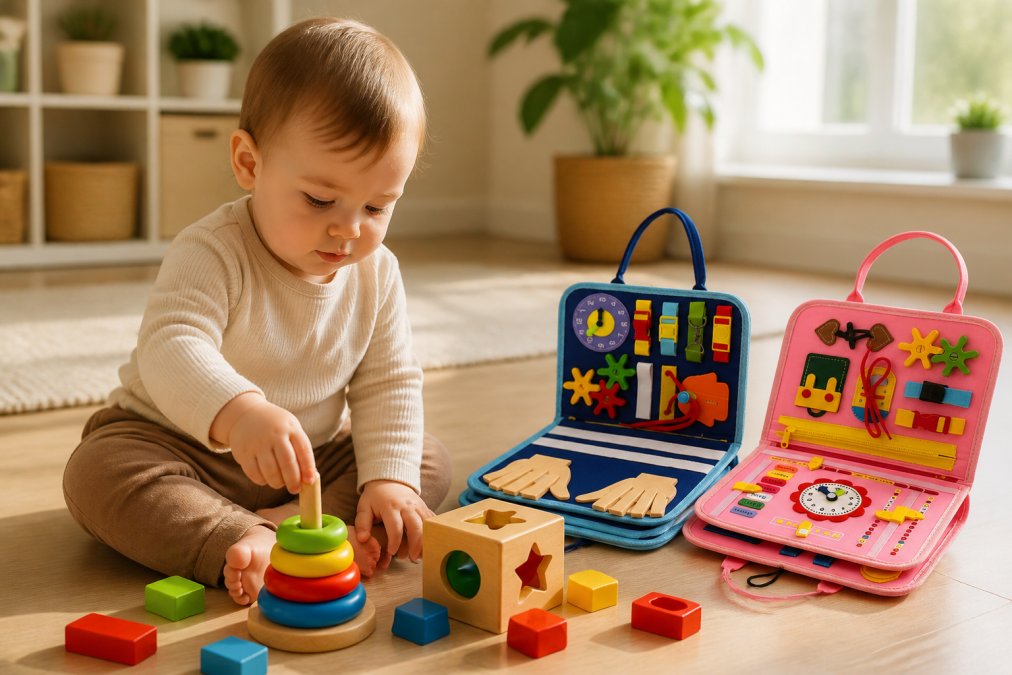
4. Montessori Toddler Busy Board
The Montessori Toddler Busy Board (AUD $40.00) is a comprehensive activity centre designed to support practical life skills and fine motor development. This felt board features 20 different activities, zips, buttons, buckles, snaps, and puzzles, all designed to build the hand coordination needed for everyday tasks.
As your child works zips and buttons, they're developing the precise finger control that will eventually lead to dressing themselves. The variety of activities means different aspects appeal to your child on different days. The portable design makes it valuable for travel and outings.
5. Wooden Rainbow Animal Stacking Toy
The Wooden Rainbow Animal Stacking Toy (AUD $33.00) combines colour recognition, shape learning, and stacking challenges into a single toy. Animal-shaped pieces in rainbow colours invite your toddler to sort by colour, stack by size, or create imaginative arrangements.
This toy supports multiple developmental pathways simultaneously: fine motor skills develop as your child grasps and positions pieces; cognitive skills develop as they figure out which pieces stack stably; visual perception develops as they identify colours and shapes. The open-ended design means your toddler can engage with the toy in different ways as their skills evolve.
6. Montessori Wooden Bear Shape Sorting and Stacking Toy
The Montessori Wooden Bear Shape Sorting & Stacking Toy (AUD $25.00) presents a charming approach to shape and colour recognition. Geometric pieces fit into corresponding slots, encouraging your toddler to match shapes and colours while solving problems independently.

The bear theme adds imaginative play elements. Your child might talk to the bear, pretend to feed it shapes, or create stories around it. This narrative layer extends engagement beyond the pure puzzle aspect.
7. Soft Baby Crinkle Cloth Book
The Soft Baby Crinkle Cloth Book (AUD $18.00) supports sensory exploration through a different modality than rigid toys. This soft fabric book features crinkle sounds, textured pages, and peek-a-boo elements designed to engage multiple senses.
The combination of visual stimulation, tactile feedback, and auditory input creates rich sensory experiences. Unlike electronic toys, your toddler controls the sensory input. The portability and washability make it valuable for travel and outings.
8. Montessori Felt Quiet Book
The Montessori Felt Quiet Book (AUD $45.00) represents a step up in complexity, ideal for toddlers at the higher end of the 14-month range. This farm-themed quiet book features interactive activities, Velcro elements, removable pieces, and finger puppets that invite sustained engagement.
Your toddler can manipulate Velcro elements to create scenes, move characters around, and tell stories. This combination of fine motor practice and narrative play supports both physical development and cognitive growth while developing sustained focus.
9. Montessori Wooden Rainbow Blocks
The Montessori Wooden Rainbow Blocks (AUD $42.00) are a premium investment in open-ended play. This 12-piece arch stacking set invites your toddler to create structures, balance pieces, and explore spatial relationships through play.
There's genuinely no single "correct" way to use them. Your toddler might stack them into towers, create arches, arrange them in lines, or use them as props for imaginative play. This flexibility means the toy remains engaging as your child's skills and interests evolve.
Montessori Activities for 14-Month-Olds
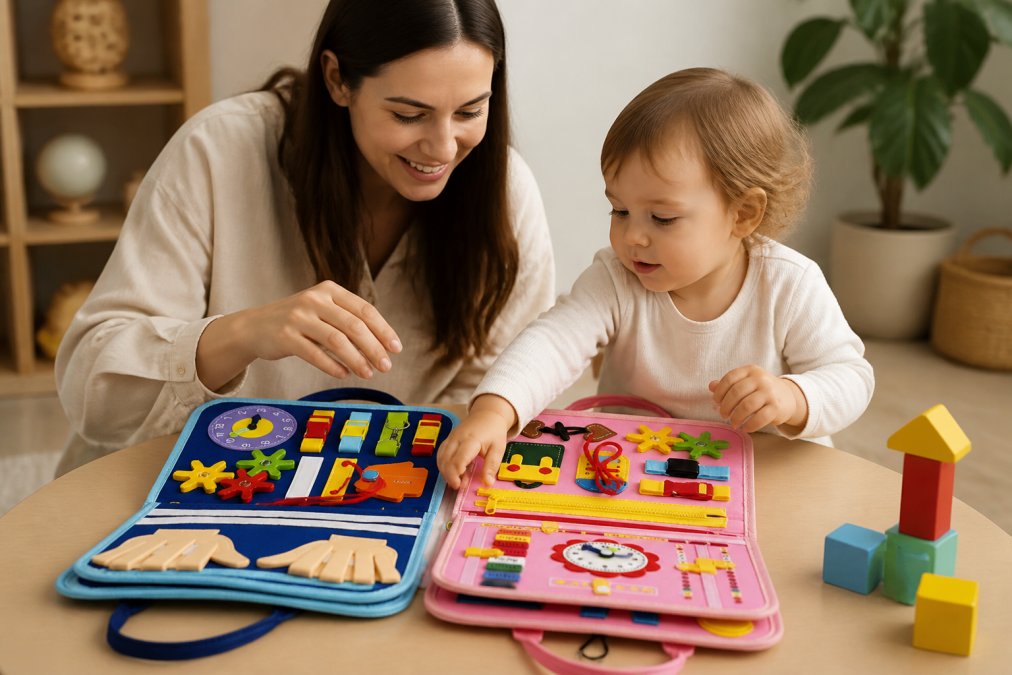
Beyond purchasing toys, how you set up your home and engage with your toddler matters enormously. The Montessori approach emphasizes creating a prepared environment where your child can explore independently while you observe and gently guide.
At 14 months, your toddler is developing autonomy and a drive toward independence. Rather than fighting this impulse, Montessori practice channels it productively. Practical life activities, setting toys on shelves, helping with simple tasks, exploring natural materials, become the foundation of learning. Your toddler might help you sort wooden spoons from plastic ones, arrange toys on a low shelf, or explore a basket of safe natural objects.
Sensory exploration activities invite your child to experience the world through their senses. Exploring different textures, listening to different sounds, and observing colours and shapes all support cognitive development. The key principle is observation: rather than constantly directing your toddler's play, follow their lead and observe what captures their attention.
How to Rotate Toys Montessori-Style
One of the most common challenges parents face is toy overload. The Montessori approach to this problem is toy rotation, a practice that keeps your child engaged while reducing overwhelm.
The principle is simple: rather than having all toys available simultaneously, you rotate a curated selection in and out of your child's environment. This keeps toys feeling fresh and novel, which sustains engagement. It also reduces decision fatigue, your toddler has fewer choices, which paradoxically makes it easier for them to commit to deep play.
Divide your toys into 3-4 groups of similar size and complexity. Keep one group accessible in your play space. Store the others out of sight. Every 2-3 weeks, swap the accessible group for a stored one. Your toddler experiences toys as "new" again, even though they're familiar.
At 14 months, aim for 5-7 toys in your active rotation, enough variety to support different moods and developmental interests, but not so many that your toddler feels paralysed by choice. Include a mix of toy types: something for stacking, something for sorting, something for sensory exploration, something for imaginative play.
When rotating, pay attention to what your toddler actually engages with. If a toy sits untouched for weeks, it might be too advanced, not interesting to your child, or simply not the right fit for this developmental stage.
Budget-Friendly and DIY Alternatives
Premium Montessori toys are genuinely valuable, but they're not the only way to support your toddler's development. Many Montessori principles can be applied using household items and DIY alternatives that cost far less.
Natural materials from around your home can become engaging toys. A basket of wooden spoons, smooth stones from the garden, or fabric scraps all invite sensory exploration and problem-solving. Your toddler learns just as much from figuring out how to stack wooden spoons as from stacking a purpose-built toy.
Simple sorting activities cost almost nothing. Fill a container with dried pasta and give your toddler a spoon to transfer pasta between bowls. Provide a basket of safe household items, wooden clothespins, plastic containers, fabric scraps, and let your toddler explore sorting and arranging them.
Musical exploration doesn't require a purchased instrument set. Fill containers with different materials (rice, beans, pasta) and seal them securely. Your toddler shakes each one, discovering how different materials create different sounds. Stacking and balancing challenges can be created from household items like plastic cups or wooden blocks.
The advantage of DIY alternatives is flexibility. The disadvantage is that household items often lack the aesthetic refinement and durability of purpose-built toys. Mixing premium toys with DIY alternatives gives you the best of both worlds.
Troubleshooting: When Your Child Loses Interest
It's frustrating when you invest in a toy, especially a premium one, only to have your toddler ignore it. Before assuming the toy was a mistake, consider several possibilities.
Your toddler might not yet have the skills to engage with the toy meaningfully. A toy that's too advanced sits unused. Store it for a few months and reintroduce it later. Many toys that seem boring at 14 months become fascinating at 16 or 18 months.
Alternatively, your toddler might be overstimulated by too many toys. When there are too many options, some children struggle to commit to any single activity. Try reducing the number of accessible toys and seeing if engagement improves.
Your toddler's developmental interests might simply not align with what the toy offers. Some children are drawn to sensory exploration, others to problem-solving, others to imaginative play. This isn't a failure, it's simply recognising that different children have different preferences.
Environment matters too. A toy abandoned on a shelf gets ignored. The same toy placed at your toddler's eye level, in a calm play space, often becomes engaging. Sometimes a toy needs introduction: sit with your toddler and show them one way to use it. Often, this gentle introduction sparks engagement that wouldn't happen if the toy was simply left out.
If a toy genuinely isn't working after these adjustments, let it go. Not every toy is right for every child. Passing it to another family or storing it for a younger sibling is perfectly reasonable.
Choosing the best Montessori toys for 14 month old children means balancing safety, developmental appropriateness, and open-ended play potential. The toys Lulliyotoys offers, from the Wooden Colour & Shape Sorting Puzzle to the comprehensive Busy Board, are designed with these principles at their core. They invite your toddler to be an active agent in their own learning, building confidence and skills through self-directed exploration. When you combine quality toys with a prepared environment and your attentive observation, you create the conditions for genuine developmental growth. Start with one or two toys that match your child's current interests, observe how they engage, and expand from there. The goal isn't accumulating toys, it's providing the right tools for your unique child at this particular developmental stage.

Frequently Asked Questions
What Montessori toys are most appropriate for a 14-month-old?
At 14 months, children benefit from toys that support fine motor skills, hand-eye coordination, and problem-solving. Montessori toys for this age include shape sorters, stacking blocks, musical instruments, and busy boards. Look for toys made from natural wood, with bright colours, and designed for independent play. Avoid toys with small detachable parts, and always check that materials are non-toxic and meet safety standards.
Are wooden toys better for 14-month-old development than plastic alternatives?
Wooden toys offer distinct developmental advantages. They provide natural tactile feedback, durability, and a warmer feel that encourages sustained engagement. Natural wood also reduces exposure to synthetic chemicals. Wooden toys tend to inspire open-ended, imaginative play rather than single-function activities. They're heavier and more substantial, which helps develop grip strength and hand-eye coordination. For Montessori-aligned play, wooden toys align with the philosophy of using natural, beautiful materials.
How do I know if a toy is truly non-toxic and safe for my 14-month-old?
Check for certifications like CE marking (required in Europe and recognised in many markets), FSC certification for wood sourcing, and water-based paint or natural finishes. Ask manufacturers directly about testing for harmful substances like lead, cadmium, and phthalates. Review product descriptions for non-toxic claims backed by specific standards. Avoid toys with loose parts, sharp edges, or paint that chips easily. Always supervise play, especially since 14-month-olds still mouth objects frequently.
My child loses interest in toys quickly. Why should I invest in premium Montessori toys?
Quality Montessori toys hold engagement longer because they're designed for open-ended play with multiple ways to use them. A shape sorter can be stacked, sorted, counted, or used imaginatively. Premium toys are also built to last through multiple children or years of use, reducing waste and long-term cost. Rotating toys strategically (rather than having everything out at once) also renews interest. When toys are beautifully made and purposefully designed, children naturally engage more deeply and for longer periods.
What's the difference between Montessori-inspired and true Montessori toys?
Montessori-inspired toys follow the philosophy of natural materials, open-ended play, and developmental appropriateness, but may not be used in official Montessori classrooms. True Montessori materials are specifically designed for the Montessori method and often used in certified schools. For home use, Montessori-inspired toys are excellent and more accessible. Both emphasise child-led learning, minimal adult direction, and toys that isolate a single skill (like shape recognition or fine motor control) rather than overstimulating with multiple functions.
This article was written using GrandRanker