

How to Foster Independent Play: A Step-by-Step Guide
Table of Contents
- What Independent Play Means and Why It Matters
- Step 1: Create a Safe, Inviting Play Space
- Step 2: Choose the Best Toys for Independent Play
- Step 3: Start Small and Build Play Duration Gradually
- How Long Should a Child Play Alone: Age-Based Guidelines
- Step 4: Position Yourself as an Observer, Not a Director
- Independent Play Activities for Toddlers: Practical Ideas
- Step 5: Manage Interruptions and Build Self-Regulation
- Common Mistakes to Avoid When Fostering Independent Play
- Conclusion
Last Updated: August 19, 2026
What Independent Play Means and Why It Matters
Independent play is when a child engages with toys, activities, or their environment on their own terms, without adult direction or constant interaction. Children who develop strong independent play skills show better self-regulation, deeper focus, and more creative thinking over time. They learn to sit with boredom instead of demanding stimulation, a skill that gets harder to build as kids get older. Research on unstructured play consistently shows that time spent in child-led activity correlates with better cognitive development and emotional resilience.
At Lulliyotoys, we design toys specifically to support this kind of independent engagement. Our Montessori-inspired approach starts with the idea that children learn best when they're driving their own exploration. The challenge most parents face is knowing how to actually step back.
Step 1: Create a Safe, Inviting Play Space
Before your child can play independently, they need a physical environment that makes it possible. Choose a corner or section of a room where your child can play without constant supervision from across the house. The space should be visible to you (safety matters), but far enough away that you're not hovering.
Safety comes first. Remove hazards appropriate to your child's age: for infants and younger toddlers, secure furniture, remove small objects, cover electrical outlets, and ensure toys have no sharp edges. For older toddlers and preschoolers, focus on preventing falls and ensuring age-appropriate toys.
Keep the space uncluttered. Too many toys creates overwhelm, not engagement. Research suggests children actually play longer and more creatively with fewer options. A good rule is 5-8 toys available at once, rotated regularly. Natural light is ideal and reduces visual stress. Low shelving is a game changer, when toys are at your child's eye level and within reach, they can choose independently without asking for help.
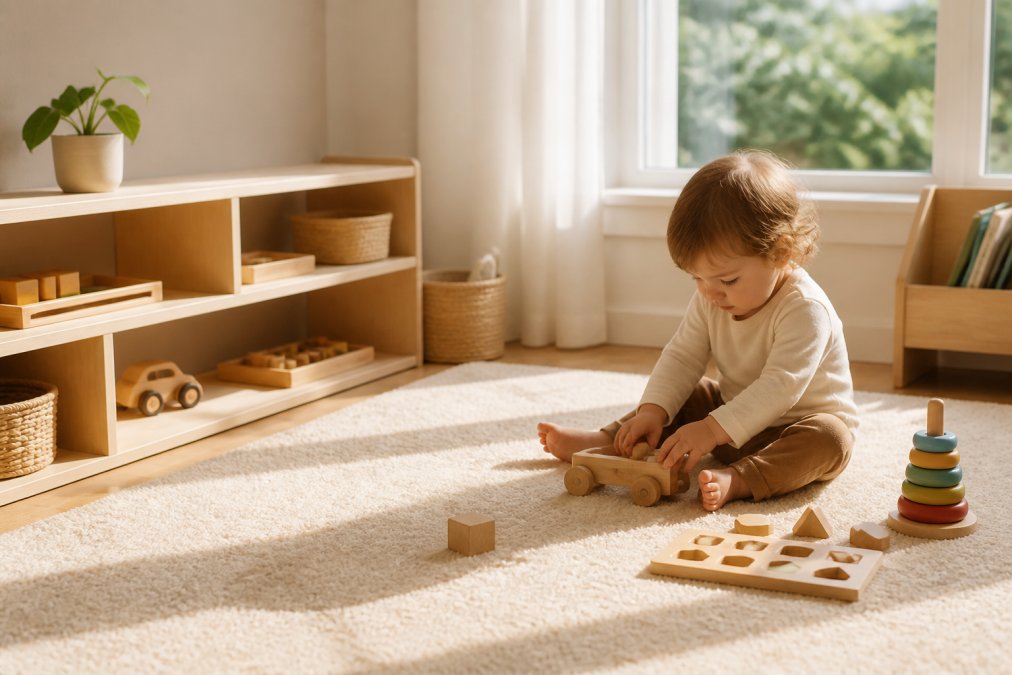
Consider sensory elements. A soft rug defines the space, cushions invite sitting, and natural materials (wood, fabric, untreated materials) feel better to touch than plastic. These details signal that this is a thoughtful, intentional space.
Step 2: Choose the Best Toys for Independent Play
The best toys for fostering independent play are open-ended, they can be used in multiple ways and don't have a single "correct" solution. Open-ended toys include wooden blocks, stacking toys, simple puzzles, and sensory materials like natural wood pieces or fabric scraps. A 12-month-old stacks blocks and knocks them down. A 2-year-old builds simple structures. A 3-year-old builds more complex designs and tells stories about what they've made. The same toy grows with your child.
Avoid toys that require batteries, make noise unprompted, or have a single programmed function. These toys interrupt independent play because they demand attention rather than inviting exploration. They also tend to overstimulate, making it harder for children to focus on quieter, more creative play.
Sensory toys matter too. Materials like natural wood, untreated fabric, and non-toxic finishes aren't just safer, they feel better and support deeper engagement. Consider toys that build specific skills your child needs: fine motor skills develop through stacking and manipulating small objects; cognitive development happens with puzzles; social-emotional learning comes through pretend play.
The Montessori Toddler Busy Board from Lulliyotoys combines multiple skill-building activities, latches, buttons, and zippers, in one toy designed for independent exploration without adult direction. Age matters: a toy that's too advanced frustrates your child and ends independent play, while a toy that's too simple bores them. The sweet spot is toys that offer a gentle challenge.

Step 3: Start Small and Build Play Duration Gradually
Independent play is a skill children develop over time. Starting with realistic expectations prevents frustration for both of you.
For infants (4-12 months), independent play might be 5-10 minutes of focused activity. For toddlers (12-24 months), expect 10-20 minutes initially. By 24 months, 30 minutes becomes realistic for some children. The key is consistency. Short, regular sessions of independent play build the habit better than occasional long stretches. Aim for at least one dedicated independent play session daily, ideally at a time when your child is well-rested and fed.
Start with a toy you know your child enjoys. Once they're engaged, step back fully. Don't hover, don't offer suggestions, don't redirect. Expect resistance initially, especially if your child is used to constant interaction. Stay calm, reassure them briefly ("I'm right here, you're safe"), and return to your own activity. Track progress week to week, not day to day. Over weeks, the average duration increases.
How Long Should a Child Play Alone: Age-Based Guidelines
For infants aged 4-8 months, independent play means exploring a toy for 5-10 minutes before needing your interaction.
For infants aged 8-12 months, aim for 10-15 minutes of sustained focus on a single toy.
For toddlers aged 12-18 months, expect 15-20 minutes of independent play, though some may manage only 10 minutes.
For toddlers aged 18-24 months, many children can sustain 20-30 minutes of independent play if the environment is right.
For preschoolers aged 2-3 years, 30-45 minutes becomes realistic for many children.
For preschoolers aged 3+ years, 45-60 minutes of independent play is achievable, especially with open-ended activities.
These are guidelines, not targets. Your child's actual duration depends on temperament, developmental stage, and how engaging the activity is. Quality matters more than quantity. Fifteen minutes of genuinely focused, independent play is better than 30 minutes of restless, interrupted activity.
Step 4: Position Yourself as an Observer, Not a Director
This step separates parents who successfully foster independent play from those who struggle with it. Your role shifts from entertainer or teacher to observer and guardian.
When your child is playing independently, your job is to watch without intervening. Be present and aware, available if safety becomes an issue, but otherwise invisible. The temptation to direct is strong. Resist it. When you step in to "help," you interrupt their problem-solving process. Even small comments like "What are you building?" break their focus and shift control from them to you.
Observation is an active skill. Watch for signs of genuine struggle versus productive struggle. Genuine struggle looks like frustration, tears, or giving up. Productive struggle looks like persistence, trying different approaches, and sticking with a challenge. Only genuine struggle warrants gentle support, and even then, ask questions rather than providing answers: "What do you think might work?" instead of "Try this."
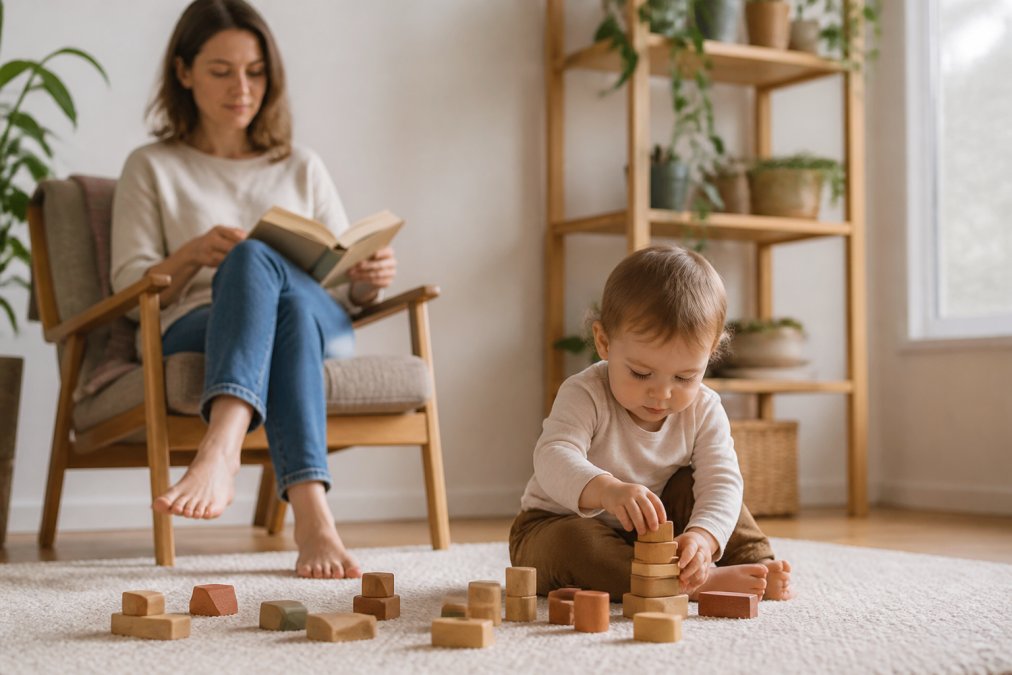
Set a timer for your independent play session and commit to not intervening unless there's a safety issue. This builds your confidence in stepping back and helps your child learn that they can sustain focus without your input.
Independent Play Activities for Toddlers: Practical Ideas
For infants aged 6-12 months: Exploration baskets filled with safe objects, wooden spoons, fabric scraps, plastic containers, soft balls. Stacking cups or rings. Sensory play with natural materials: smooth stones, large wooden beads, or fabric squares.
For toddlers aged 12-24 months: Building with soft blocks or wooden blocks. Simple puzzles with 2-4 large pieces. Pretend play with dolls, toy animals, or simple figures. Play with containers and objects to put in and take out.
For preschoolers aged 2-3 years: Open-ended building projects with blocks or Lego Duplo. Art activities: crayons and paper, playdough, or paints. Pretend play scenarios: a play kitchen, a doctor's kit, or a shop setup. Sorting and categorising activities by colour, size, or type.
The Montessori Felt Quiet Book from Lulliyotoys combines multiple activities (zipping, buttoning, matching) in one portable toy, making it ideal for independent play. What these activities share is openness, there's no single correct outcome, which means your child can't "fail" and keeps trying.

Step 5: Manage Interruptions and Build Self-Regulation
Independent play doesn't happen in a vacuum. Real life involves interruptions, siblings, pets, and household noise. Managing these interruptions teaches your child self-regulation in the face of disruption.
Minimise interruptions when possible. Turn off notifications, let other family members know it's independent play time, and defer non-urgent tasks. When interruptions do happen, briefly address the need, then redirect your child back to play: "Your brother needed help. Now you can go back to your blocks."
Some children struggle more with transitions. If your child becomes dysregulated when interrupted, build in a transition warning five minutes before independent play ends. Toy rotation maintains novelty and engagement without requiring constant purchases. A toy that seemed boring three weeks ago feels fresh again after a break.
For neurodivergent children or those who struggle with focus, shorter, more frequent sessions work better than longer blocks. Adapt the approach to your child's actual needs, not a generic ideal. Self-regulation grows over time. Your role is to gradually increase expectations as their capacity grows, while still offering support when they need it.
Common Mistakes to Avoid When Fostering Independent Play
Introducing too many toys at once. A child faced with 20 toy options becomes overwhelmed. Start with 5-8 toys and rotate regularly.
Expecting immediate independence. Build gradually, session by session, week by week.
Intervening too quickly. Let your child sit with productive struggle for a bit longer.
Playing alongside without being asked. If you join in, you've shifted the activity from child-led to adult-directed.
Using independent play as a way to get things done. Frame it as your child's time to explore and play, not time when you're unavailable.
Choosing toys that are too advanced or too simple. Observe what actually engages your child and build from there.
Not accounting for developmental differences. A child with sensory sensitivities might need a quieter space. A child with attention differences might need shorter sessions.
Feeling guilty about stepping back. Allowing your child to play independently is one of the most important things you can do for their development. It's not neglect, it's intentional parenting.
Fostering independent play is one of the most valuable skills you can build with your child. It takes patience, a thoughtful environment, and the willingness to step back, but the payoff is a child who can entertain themselves, solve problems, and trust their own thinking. Start with a safe space, choose toys that invite exploration, and commit to observing rather than directing. The Montessori Wooden Train Set from Lulliyotoys is designed for exactly this kind of open-ended play and invites hours of independent exploration. As your child develops this capacity, you'll notice something shift: they become more confident, more creative, and more genuinely engaged. That's independence taking root.

Frequently Asked Questions
At what age can children start playing independently?
Infants as young as 6-8 months can begin short periods of independent play under supervision, though attention span is brief. By 12-18 months, toddlers can sustain 10-15 minutes of unstructured play. Preschoolers (3-4 years) often manage 20-30 minutes. Start with realistic expectations for your child's developmental stage and gradually extend duration as their self-regulation and attention span improve.
What are the best toys for independent play?
Open-ended toys that spark creativity work best: wooden building blocks, stacking toys, busy boards, and quiet books. Avoid toys that require constant adult input or have single-use functions. The Montessori Toddler Busy Board and Wooden Animal Balance Stacking Toy are designed to encourage problem-solving and fine motor skill development without needing your involvement. Rotate toys regularly to maintain engagement and prevent over-stimulation.
How do I handle my guilt about not playing with my child constantly?
Independent play is not neglect, it's essential for cognitive and emotional development. Children who play alone develop intrinsic motivation, creative thinking, and self-regulation. Observing from nearby allows you to stay present without directing the activity. Quality time together matters more than constant engagement. Setting boundaries around independent play also models healthy autonomy and helps your child build confidence in their own abilities.
What should I do if my child refuses to play independently?
Refusal often stems from habit, anxiety, or lack of exposure. Start by sitting nearby without playing, gradually increasing distance over weeks. Use toys that naturally invite exploration, like the Montessori Felt Quiet Book, which engages multiple senses. Avoid rushing; some children need longer adjustment periods. If your child is neurodivergent, sensory sensitivities or need for movement may require adapted strategies, consider fidget tools, weighted items, or shorter, more frequent play sessions rather than one long stretch.
This article was written using GrandRanker