

How to Choose Learning Toys for a 1 Year Old
Table of Contents
- What a 1-Year-Old Actually Needs From Learning Toys
- Safe Materials for Toddler Toys: What to Check Before You Buy
- How Learning Toys Support Fine and Gross Motor Skills
- Sensory Exploration and Cognitive Development Through Play
- Language Acquisition, Auditory Stimulation and Board Books
- Montessori-Inspired Play Principles for 1-Year-Olds
- Best Educational Gifts for Toddlers 2026: Top Categories to Consider
- How to Rotate Toys for Toddlers to Sustain Engagement
- DIY Learning Activities and Storage Solutions at Home
- Developmental Red Flags: When a Toy Isn't Working
Last Updated: August 17, 2026
Choosing the right learning toys for a 1 year old is one of those decisions that feels simple until you're standing in a toy aisle (or scrolling at midnight) wondering whether you're about to waste money on something your toddler will ignore by Thursday. At Lulliyotoys, we work with this exact question every day, and the honest answer is: most parents are overthinking the wrong things and underthinking the right ones. This guide breaks down what developmental science actually tells us, what safety labels to trust, and how to build a toy environment that keeps a one-year-old genuinely engaged, not just briefly distracted.
What a 1-Year-Old Actually Needs From Learning Toys
Learning toys for a 1 year old don't need to be flashy, electronic, or expensive. They need to match where your child actually is developmentally, not where the marketing says they should be.
At this age, the brain is making connections at a rate it will never match again. Simple, open-ended objects that respond predictably to a child's actions, a block that stacks, a lid that fits, a shape that drops through a hole, are doing serious cognitive work. The toy doesn't need to do the entertaining. The child does.
Toddler Milestones to Keep in Mind
Toddler milestones at 12 months typically include pulling to stand, cruising along furniture, taking first steps, using a pincer grasp, and beginning to imitate actions they observe. Cognitive development at this stage centres on cause and effect: "I drop this, it falls. I press this, it makes a sound."
Language acquisition is also beginning in earnest. Most one-year-olds understand far more words than they can produce, which means toys that name objects, repeat sounds, or invite pointing are genuinely useful, not just cute. Spatial awareness is developing too: fitting objects into containers, nesting cups, and simple puzzles all build the mental mapping skills that underpin later maths and problem-solving.
A common mistake is buying toys pitched at "12-18 months" that are actually calibrated for the 18-month end of that range. If a toy requires skills your child doesn't have yet, it won't hold their attention and it won't teach anything. Match the toy to where they are right now, not where they'll be in six months.
Open-Ended vs Closed-Ended Toys
Open-ended play refers to any activity with no single correct outcome: stacking blocks, filling and emptying containers, exploring textures. Closed-ended toys have a defined goal, such as a shape sorter where each piece fits only one hole.
Both have genuine value. Closed-ended toys build problem-solving, persistence, and the satisfaction of mastery. Open-ended toys build imagination, independent play, and creativity. The mistake is buying only one type.
A good rule of thumb: for every closed-ended toy, have two open-ended ones. The closed-ended toy teaches a specific skill; the open-ended one lets your child practise it in their own way.
Safe Materials for Toddler Toys: What to Check Before You Buy
Safe materials for toddler toys matter more at this age than at any other, because one-year-olds put everything in their mouths. This is not a quirk. It is a primary sensory exploration strategy, and any toy in your child's hands will eventually end up between their teeth.
The good news is that checking safety is simpler than the marketing noise suggests. The bad news is that not every brand makes it easy.
Australian Safety Standards to Look For
Toys sold in Australia must comply with the mandatory safety standard under the Australian Competition and Consumer Commission (ACCC) product safety standards for toys. This standard covers choking hazards, sharp edges, flammability, and toxic substance limits. Look for toys that explicitly reference compliance with AS/NZS 8124, which is the Australian and New Zealand standard for toy safety.
A toy that carries a CE mark (European standard) is not automatically compliant with Australian requirements. These marks indicate the toy has passed testing in their respective markets, but they are not substitutes for AS/NZS 8124 compliance. When in doubt, ask the retailer directly.
Spotting Greenwashing vs Genuinely Non-Toxic Materials
"Natural", "eco-friendly", and "non-toxic" are marketing terms, not certifications. A toy can carry all three labels and still contain finishes that are not safe for mouthing.
Genuinely non-toxic wooden toys will typically specify: water-based or food-grade paint and stains, no formaldehyde-based adhesives, and FSC-certified timber sourcing. FSC certification (Forest Stewardship Council) means the wood was harvested from responsibly managed forests, which is an environmental claim, not a safety one. These are separate things.
Ask for the specific finish used, not just the wood type. A toy made from FSC-certified beech but coated in a solvent-based lacquer is not safe for mouthing. A toy made from non-certified pine with a beeswax finish probably is. The finish matters more than the timber source for safety purposes.
How Learning Toys Support Fine and Gross Motor Skills
Motor skill development at age one is rapid and uneven. Most children are somewhere between cruising and walking, between raking objects with their whole hand and using a proper pincer grasp. The best learning toys meet children in that gap rather than waiting for skills to fully arrive.
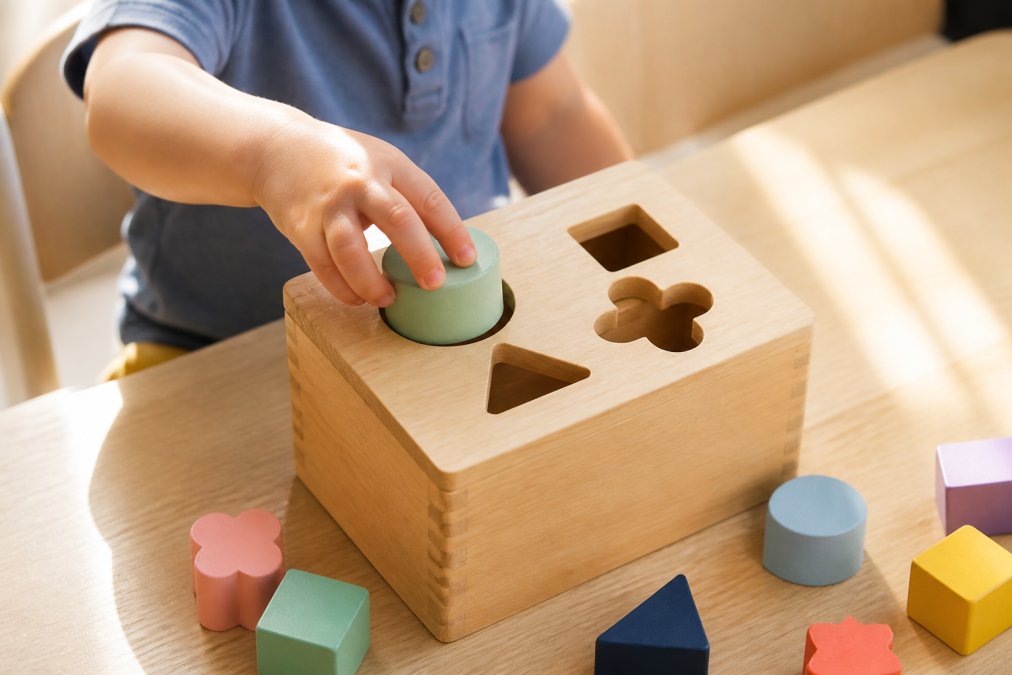
Fine Motor Skill Builders: Sorting, Stacking and Grasping
Fine motor skills are the small, precise movements of the hands and fingers. At one year, these are still developing rapidly. Toys that require grasping, rotating, inserting, and releasing are doing the most work here.
The Montessori Wooden Bear Shape Sorting & Stacking Toy from Lulliyotoys is a good example of how sorting and stacking can work together. The child must identify the correct shape, orient it correctly, and release it into the right space, three separate fine motor and cognitive steps in a single play action. Similarly, the Montessori Wooden Color & Shape Sorting Puzzle adds colour recognition to the same physical challenge, building hand-eye coordination alongside shape awareness.


Stacking rings, nesting cups, and simple peg puzzles all serve the same function. The key is that the toy offers resistance: something that requires genuine effort to manipulate, but not so much effort that it becomes frustrating.
Gross Motor and Mobility Play
Gross motor skills involve the large muscle groups: crawling, pulling to stand, walking, and climbing. Toys that encourage mobility, rather than keeping a child seated, are doing important developmental work.
Push-along toys that a cruising toddler can hold for balance, low-level climbing structures, and soft balls for rolling and chasing all support gross motor development. The goal is to give a one-year-old a reason to move, not just something to sit and manipulate.
A common mistake here is buying toys that are too passive. A shape sorter is excellent for fine motor development, but a child also needs toys that get them up and moving. Balance both in your selection.
Sensory Exploration and Cognitive Development Through Play
Sensory exploration is how one-year-olds build their understanding of the physical world. Every time a child squeezes a soft toy, bangs a wooden block on the floor, or drops a ball and watches it roll, they are running a small experiment. Tactile stimulation, auditory feedback, and visual tracking are all forms of data collection for a developing brain.
Toys with varied textures, weights, and sounds give children more data to work with. This is why wooden toys often outperform plastic ones for this age group: natural timber has grain, weight, and temperature variation that smooth plastic does not. The tactile experience is richer.
Cognitive development at this stage is also closely tied to repetitive play. A child who drops the same object off their high chair tray twenty times is not being annoying. They are testing a hypothesis: does gravity work every time? Toys that support this kind of repetition, stacking rings that can be knocked down and rebuilt, containers that can be filled and emptied, are serving a genuine developmental purpose.
According to [EXTERNAL_LINK: the American Academy of Pediatrics' guidance on play and child development | publications.aap.org], play is the primary vehicle through which children develop cognitive, physical, social, and emotional skills in early childhood. Simple, hands-on toys consistently outperform screen-based alternatives for this age group.
Language Acquisition, Auditory Stimulation and Board Books
Language acquisition at one year is happening faster than most parents realise. Children at this age are building a receptive vocabulary, words they understand, that significantly outpaces their expressive vocabulary, words they can say. The gap is normal, and the best way to support it is through rich verbal interaction paired with objects they can see and touch.
Board books are among the most underrated learning tools for this age. They combine auditory stimulation (hearing words read aloud) with visual tracking, page-turning (a fine motor activity), and the social experience of shared attention. A child who regularly hears the names of objects, animals, and actions in the context of pictures is building the language foundation that supports reading years later.
Toys that produce consistent, predictable sounds when activated, a drum that makes the same sound each time it is struck, a button that plays a simple melody, also support auditory discrimination and cause-and-effect understanding. The key word is predictable: random or overstimulating sound toys can actually interfere with auditory processing at this age.
Montessori-Inspired Play Principles for 1-Year-Olds
Montessori-inspired play is built on a specific idea: children learn best when they can act independently on their environment, choose their own activities, and work at their own pace without interruption. For one-year-olds, this translates into a play space with accessible, purposeful objects that the child can pick up, explore, and put away without adult assistance.
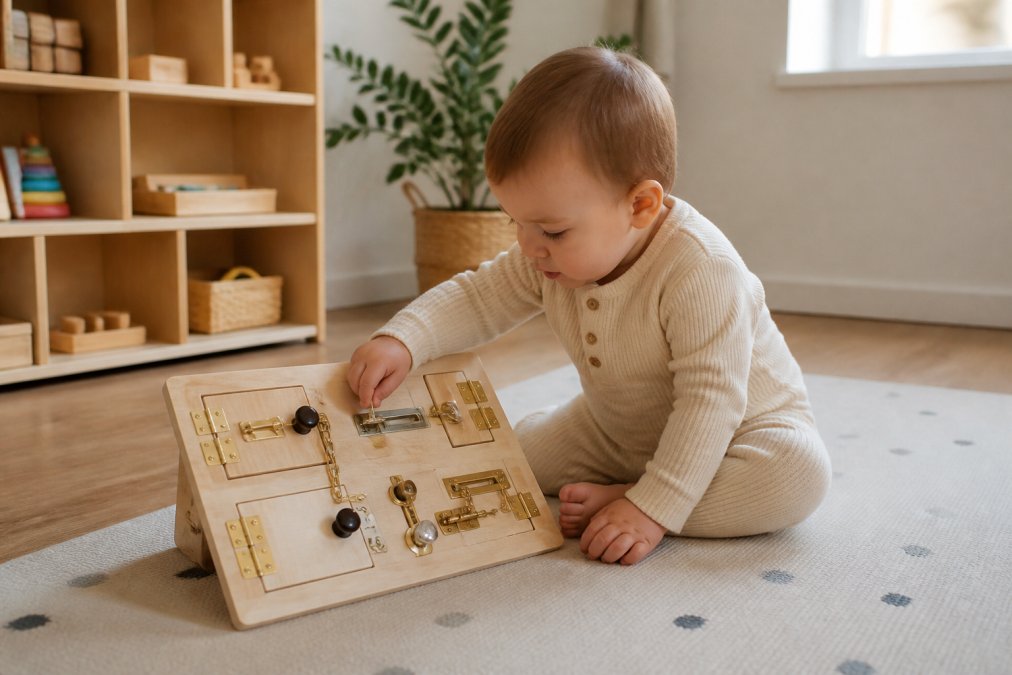
The Montessori approach does not mean expensive or minimalist for its own sake. It means intentional. Each toy in the environment should have a clear purpose, be accessible to the child, and be rotated when it no longer holds interest. The Montessori Toddler Busy Board from Lulliyotoys is designed around exactly this principle: multiple independent activities on a single board, each one practising a real-life skill (latches, knobs, buckles), accessible to a toddler working alone.

The principle of "isolation of difficulty" is worth understanding. Montessori materials typically focus on one concept at a time: one colour, one shape, one texture. This is not a limitation. It is precision. A toy that teaches red before it teaches red-and-round gives the child a clearer signal about what they are learning.
As documented in [EXTERNAL_LINK: research published by the National Association for the Education of Young Children | www.naeyc.org/resources/topics/research], child-directed, hands-on play consistently supports stronger developmental outcomes in early childhood than adult-directed or screen-mediated activities.
Best Educational Gifts for Toddlers 2026: Top Categories to Consider
The best educational gifts for toddlers in 2026 fall into a few clear categories, each supporting a different developmental domain. Here is a practical summary:
| Category | Developmental Focus | Examples |
|---|---|---|
| Shape sorters and puzzles | Fine motor, problem-solving, spatial awareness | Wooden shape sorters, peg puzzles |
| Stacking and nesting toys | Hand-eye coordination, sequencing, cause and effect | Stacking rings, nesting cups |
| Busy boards | Fine motor, independence, life skills | Lulliyotoys Toddler Busy Board |
| Board books | Language acquisition, auditory stimulation | Simple picture books with one word per page |
| Push-along toys | Gross motor, mobility, balance | Wooden push walkers |
| Open-ended blocks | Imaginative play, spatial reasoning, creativity | Unit blocks, simple wooden sets |
| Musical instruments | Auditory discrimination, cause and effect | Drums, xylophones, shakers |
The most common gifting mistake is choosing age-inappropriate toys: things that are visually appealing to adults but either too simple (boring within a day) or too complex (frustrating and ignored). Use the developmental stage, not the age range printed on the box, as your guide.
For parents who want a single starting point, shape sorting and stacking toys consistently deliver the broadest developmental return at this age. They work on fine motor skills, cognitive development, and problem-solving simultaneously, and they hold interest longer than single-purpose toys because the child can approach them in multiple ways.
How to Rotate Toys for Toddlers to Sustain Engagement
Toy rotation for toddlers is the practice of keeping only a small number of toys accessible at any time, storing the rest, and cycling them in and out on a regular basis. It is one of the most effective and underused strategies for sustaining engagement and extending the developmental life of each toy.
The logic is straightforward. A child with access to thirty toys will typically play superficially with all of them. A child with access to six toys will play deeply with each one, returning to them repeatedly and discovering new ways to use them. Deep play is where learning happens.
A practical rotation system works like this:
- Sort toys into three or four groups of roughly equal size and variety.
- Make one group accessible in the play space.
- Store the others out of sight (a box in a cupboard works fine).
- After one to two weeks, or when engagement drops noticeably, swap one group out for a stored one.
- Watch the child's reaction when "new" toys reappear: most toddlers treat returned toys with the same enthusiasm as genuinely new ones.
Toy rotation also solves the problem that many parents raise: "My kid moves between toys really fast and loses interest in everything." The issue is usually not the toys. It is the volume. Fewer choices create deeper engagement.
DIY Learning Activities and Storage Solutions at Home
Not every learning activity requires a purchased toy. Many of the most effective sensory exploration and fine motor activities for one-year-olds use objects already in the home.
DIY activity ideas that genuinely work:
- Treasure basket: Fill a low basket with safe household objects of varied textures, a wooden spoon, a small fabric scrap, a smooth river stone, a silicone spatula. Let the child explore independently. This is a classic Montessori heuristic play activity.
- Container play: Give your child a set of containers with lids of different sizes. The challenge of matching lids to containers builds fine motor skills and spatial reasoning without any specialist equipment.
- Posting box: Cut a hole in the lid of a cardboard box large enough for a large wooden block or a rolled-up sock. The child posts objects through the hole and retrieves them. Simple cause-and-effect, zero cost.
- Water play: A shallow tray with a small amount of water and a few cups and spoons provides rich sensory exploration and early understanding of volume and pouring.
- Textured sensory boards: Glue small squares of different fabrics (corduroy, velvet, hessian, cotton) onto a piece of cardboard. Mount it low on a wall or lay it flat for tactile stimulation.
For storage, low open shelving is the Montessori standard, and for good reason. When toys are visible and accessible at a child's height, independent play increases significantly. Baskets and trays work better than lidded boxes at this age because a one-year-old cannot reliably open and close lids, which means a lidded box effectively makes the toy inaccessible.
According to [EXTERNAL_LINK: guidance from the Raising Children Network, Australia's trusted parenting resource | raisingchildren.net.au], a well-organised, low-stimulation play environment supports longer periods of independent play and reduces frustration for toddlers.
Developmental Red Flags: When a Toy Isn't Working
Most of the time, a toy that a child ignores is simply not the right fit for their current developmental stage. That is not a red flag. That is useful information.
But there are situations where a child's response to toys warrants a closer look. These are not diagnoses. They are signals to discuss with your maternal and child health nurse or GP:
- A child who shows no interest in any cause-and-effect toys by 14 months, not just one or two, but consistently across all of them.
- A child who does not imitate simple actions (waving, clapping, banging a drum) by 12-14 months.
- A child who does not follow a pointed finger to look at an object by 12 months.
- A child who does not respond to their name being called consistently by 12 months.
- A child who shows no interest in other people's faces or social interaction during play.
These milestones are tracked as part of routine well-child checks under the Australian Government's universal child health checks program. If you have concerns, the right first step is your child's health professional, not a different toy.
The more common situation is simply a mismatch. A shape sorter that frustrates a child who isn't ready for it will become their favourite toy in two months. Store it, bring it back, and watch what changes.
Choosing learning toys for a 1 year old doesn't have to be complicated, but it does require knowing what you're actually looking for. The Lulliyotoys collection is built around exactly the principles covered in this guide: Montessori-inspired design, non-toxic materials, and age-appropriate developmental focus. From the Toddler Busy Board to the Wooden Bear Shape Sorting & Stacking Toy, every piece is designed to support real developmental milestones, not just look good on a shelf. Get started with Lulliyotoys and give your child toys that grow their skills, not just their toy box.
Frequently Asked Questions
What are the best learning toys for a 1-year-old?
The most effective learning toys for a 1-year-old support multiple developmental areas at once. Shape sorters build spatial awareness and hand-eye coordination; stacking toys develop fine motor skills and cause-and-effect understanding; busy boards with latches and knobs encourage independent play and problem-solving. Montessori-inspired wooden toys, like the Lulliyotoys Bear Shape Sorting and Stacking Toy, are designed specifically for this stage and hold a child's interest longer than single-function plastic alternatives.
How do I know if a toy is developmentally appropriate for my toddler?
A developmentally appropriate toy matches your child's current milestones without being frustrating or boring. For a 1-year-old, look for toys that encourage grasping, stacking, sorting, and sensory exploration. Open-ended toys that can be used in multiple ways tend to stay relevant across several developmental stages. If your child repeatedly returns to a toy and engages with it in new ways, it is working. If they ignore it entirely after a few tries, it is likely too advanced or too simple.
What safety standards should I look for in children's toys sold in Australia?
Toys sold in Australia must comply with the mandatory safety standard under the Competition and Consumer Act 2010, which references AS/NZS 8124, the Australian and New Zealand toy safety standard. This covers choking hazards, sharp edges, and chemical limits including restricted substances in materials. Look for toys that explicitly reference AS/NZS 8124 compliance. For wooden toys, FSC certification indicates responsibly sourced timber. Always check that finishes and paints are labelled non-toxic and free from heavy metals such as lead.
How many toys should a 1-year-old have at one time?
Most child development guidance suggests that fewer toys available at once leads to deeper, more focused play. A rotation of around five to eight toys at a time is a practical starting point. Toy rotation, where you store some toys and swap them out every one to two weeks, keeps the selection feeling fresh without buying more. This approach also reduces clutter, supports independent play, and helps you notice which types of toys your child genuinely connects with before investing further.
This article was written using GrandRanker