

Fine Motor Skills With Toddler Toys: A How-To Guide
Table of Contents
- What Are Fine Motor Skills and Why They Matter
- Fine Motor Skill Milestones by Age
- How to Recognise Signs of Fine Motor Delay
- Fine Motor Activities for Toddlers: Hands-On Play
- Montessori Toys for Hand-Eye Coordination
- DIY and Household Alternatives for Fine Motor Practice
- Interactive Play Techniques to Build Motor Control
- Choosing Toys That Grow With Your Toddler
- Conclusion
Last Updated: August 25, 2026
What Are Fine Motor Skills and Why They Matter
Fine motor skills are the small, precise movements your toddler makes with their hands, fingers, and wrists. These movements control everything from grasping a toy to turning a page, and they're foundational to how children learn and interact with the world around them. Unlike gross motor skills (which involve larger movements like running or jumping), fine motor development is what allows your child to manipulate objects, explore textures, and eventually write, eat independently, and dress themselves.
The reason fine motor skills matter so much is straightforward: they're how your toddler makes sense of their environment. When a child picks up a bead, threads it onto a cord, or stacks a wooden block, they're not just playing. They're building hand strength, developing hand-eye coordination, and strengthening the neural pathways that connect their brain to their hands. This sensory processing and motor planning are critical for cognitive development, problem-solving, and confidence.
At Lulliyotoys, we've designed our collection around this understanding. The toys we curate, from threading beads to stacking blocks, are intentionally chosen to support these developmental milestones through purposeful play. When you choose toys that encourage fine motor skills in toddlers, you're giving your child tools to explore independently and build competence at their own pace.
The connection between fine motor development and later academic success is real. Children who develop strong hand strength, dexterity, and bilateral coordination (using both hands together) tend to transition more smoothly into writing, drawing, and other school-based tasks. But beyond academics, fine motor control builds self-esteem. When a toddler successfully threads a bead or balances a stack of blocks, they experience genuine accomplishment.
Fine Motor Skill Milestones by Age
Understanding what's developmentally appropriate for your toddler's age prevents frustration for both of you. A toy that's too advanced sits unused; one that's too simple gets ignored. Here's what typically emerges across the early years.
12 to 18 months: At this stage, your toddler is developing their pincer grasp, the ability to pick up small objects between thumb and fingers. You'll see them picking up Cheerios, grabbing at your hair, and attempting to turn pages (though usually with both hands). Hand-eye coordination is developing, but it's still rough. They're experimenting with cause and effect: drop something, watch it fall, repeat endlessly. Toys that support this phase include large beads for threading, chunky stacking blocks, and objects with different textures to explore.
18 to 24 months: This is when precision starts to emerge. Your toddler can now stack two or three blocks, scribble with a crayon (though it won't look intentional yet), and use both hands with more coordination. They're beginning to show hand dominance, a preference for left or right. Threading becomes more deliberate, though still clumsy. Sorting activities start to make sense to them. Wrist stability is improving, which means they can manipulate objects with more control.
24 to 36 months: By age two and beyond, most toddlers can stack five or more blocks, turn pages one at a time, and draw simple lines with intention. Their grasp patterns are more refined, and they can perform repetitive motions with better muscle tone and control. Threading becomes smoother, sorting faster. This is when mark-making really takes off, they understand that their hand movements create visible results. Fine motor control is noticeably more deliberate.
The key insight here is that progression isn't linear. Some toddlers master stacking early but lag on threading. Others show advanced hand-eye coordination but weaker grip strength. These variations are completely normal. The milestones are guides, not rigid timelines.
How to Recognise Signs of Fine Motor Delay
Most toddlers develop fine motor skills on their own timeline, and variation is normal. But there are genuine signs that warrant attention. Recognising these early means you can seek support if needed, rather than waiting and wondering.
By 18 months, a typically developing toddler should be able to pick up small objects between thumb and fingers (pincer grasp) and transfer toys from one hand to the other (the CDC). If your child isn't doing this, or if they seem to favour one hand exclusively and show no interest in using the other, that's worth mentioning to your health visitor or GP.
By age two, most toddlers can stack at least two blocks, scribble intentionally with a crayon, and use both hands in coordinated ways (the NIH). If your two-year-old shows no interest in stacking, can't hold a crayon with any control, or seems to have significantly weaker grip strength in one hand, these might be signals to explore further.
Red flags that suggest you should seek professional guidance include: persistent difficulty with the pincer grasp past 20 months, significant asymmetry between left and right hand strength or control, extreme frustration with fine motor tasks (as opposed to normal toddler impatience), or a sudden loss of fine motor skills they previously had (aap.org). The last one is especially important, regression can indicate something that needs attention.
It's also worth noting that some children have sensory processing differences that affect fine motor development. A child who avoids certain textures, seems hypersensitive to touch, or has difficulty with bilateral coordination might benefit from occupational therapy assessment. This isn't a diagnosis, it's a way to get expert guidance tailored to your child's specific needs.
The good news: early intervention, when needed, is highly effective. And most toddlers simply need exposure to varied fine motor activities and toys that invite manipulation and exploration. That's where intentional toy selection comes in.
Fine Motor Activities for Toddlers: Hands-On Play
The most powerful fine motor practice happens through play that feels like play, not work. Your toddler shouldn't feel like they're doing therapy; they should feel like they're discovering something interesting. Here are the activities that build real skill while keeping engagement high.
Threading and Lacing Activities
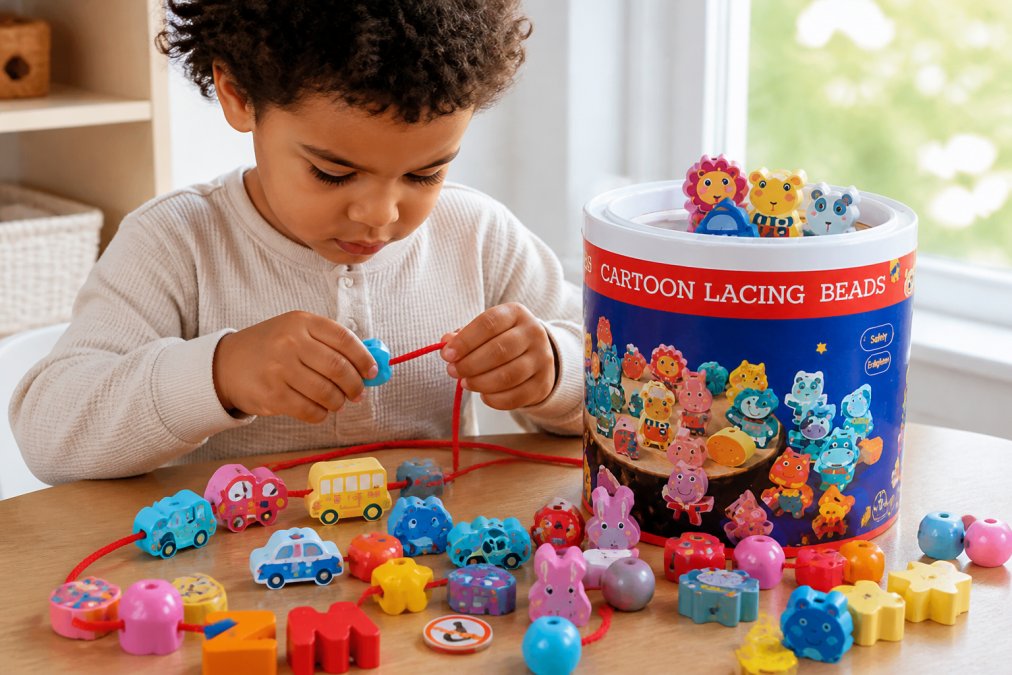
Threading is one of the most underrated fine motor builders. It combines hand-eye coordination, bilateral coordination (using both hands together), and sustained focus in a way that feels like pure play to a toddler. The act of guiding a cord through a bead requires precision, patience, and problem-solving, your child has to figure out the angle, apply the right amount of pressure, and persist when the cord doesn't slide through immediately.
Start with large beads and thick cords. The 136-Piece Wooden Lacing Beads set from Lulliyotoys is designed exactly for this phase, chunky wooden beads with large holes, cotton cords that are easy to grip, and enough variety (letters, numbers, shapes, animals) to keep a toddler interested across multiple play sessions. The beads are large enough that threading feels achievable without frustration, but challenging enough that it requires focus.

The progression is natural. Early on, your toddler might just thread a few beads randomly. Over weeks, they'll thread longer sequences, notice patterns, and start to create intentional designs. They're building hand strength, wrist stability, and visual-motor integration without realising they're working.
A household alternative: large pasta (like rigatoni or penne) threaded onto yarn works surprisingly well. It's free, it's tactile, and the slight resistance as the pasta slides onto the cord provides good sensory feedback. Just supervise closely, as toddlers still put things in their mouths.
Stacking and Sorting Games
Stacking builds hand-eye coordination and spatial awareness. Sorting builds visual discrimination and fine motor control through repetitive, purposeful motion. Both are calming activities that toddlers naturally gravitate toward.
The Montessori Wooden Bear Shape Sorting & Stacking Toy combines both in one. Your toddler can stack the bear-shaped pieces, sort by colour or shape, and engage in open-ended play that evolves as they develop. Early on, they're just exploring the shapes and colours. Later, they're intentionally matching and stacking. The toy grows with them because there's no single "right way" to play.

Stacking requires wrist stability and finger isolation (using specific fingers rather than the whole hand). Sorting requires precision and the ability to compare objects, is this one the same colour as that one? The repetitive motion of sorting builds muscle tone and endurance in the small muscles of the hand.
For household alternatives: plastic containers and objects to sort (wooden spoons, plastic cups, fabric scraps). Your toddler can sort by colour, size, or texture. It's free, it's tactile, and it's genuinely engaging. The variety of textures, smooth plastic, rough fabric, cold metal, provides rich sensory input.
Grasping and Manipulation Exercises
Grasping isn't just about holding something; it's about controlling how tightly you grip, adjusting your grip based on what you're holding, and using different grasp patterns for different objects. These skills develop through play with objects that invite different types of manipulation.
The Wooden Animal Balance Stacking Toy from Lulliyotoys requires careful grasping and precise placement. Your toddler has to hold each animal piece with enough control to place it on the stack without toppling the tower. This builds hand strength, focus, and problem-solving. The challenge level is perfect for toddlers, achievable enough to feel rewarding, difficult enough to be engaging.

Manipulation exercises don't have to be fancy. Playdough is a classic for good reason. Rolling, squishing, poking, and pulling playdough builds hand strength and gives immediate sensory feedback. Your toddler controls the pressure, the speed, and the outcome. It's endlessly engaging and genuinely develops the small muscles in their hands.
Household alternative: crumpling paper. Give your toddler newspaper or scrap paper and let them crumple it into balls. It's tactile, it's loud, it's satisfying, and it builds hand strength. Later, you can sort the balls by size or colour.
Montessori Toys for Hand-Eye Coordination
Montessori philosophy emphasises purposeful, self-directed play with materials that isolate specific skills. When it comes to hand-eye coordination, Montessori toys are deliberately designed to invite precise movement and provide immediate, clear feedback.
The core principle is this: the toy should be beautiful enough to invite engagement, simple enough to be understood quickly, and challenging enough to hold attention. There's no flashing lights, no batteries, no overwhelming sensory input. Just clean design, natural materials, and a clear invitation to explore.
Hand-eye coordination develops when your toddler repeatedly practices connecting what they see with what their hands do. Threading a bead requires looking at the cord and the hole, then coordinating hand movement to thread the cord through. Stacking requires looking at the blocks and the growing tower, then coordinating hand placement. Sorting requires comparing objects visually, then moving them to the correct pile.
Montessori materials typically use natural wood, muted colours, and minimal ornamentation. This isn't aesthetic preference alone, it reduces visual distraction and helps toddlers focus on the task itself. The Montessori Toddler Busy Board from Lulliyotoys exemplifies this. It features 20 different activities (clocks, puzzles, occupation themes, letters, numbers, colours, shapes) all designed to build fine motor control and everyday life skills. Each activity is distinct and purposeful. Your toddler can spend five minutes on one activity and move to another, or focus deeply on a single challenge.
The beauty of Montessori-inspired toys is that they invite mastery. Your toddler isn't trying to beat a game or achieve a score. They're simply exploring, discovering, and building competence through repetition. That sense of agency and accomplishment is powerful.
DIY and Household Alternatives for Fine Motor Practice
Premium toys are wonderful, but fine motor development doesn't require them. Your kitchen and recycling bin contain dozens of materials that build the same skills.
Pasta threading: Rigatoni, penne, or large macaroni threaded onto yarn or string. The resistance as the pasta slides onto the cord provides excellent sensory feedback. Supervise closely.
Paper tearing: Give your toddler newspaper or scrap paper and let them tear it into pieces. It's loud, it's satisfying, and it builds hand strength. Later, you can sort the pieces by size.
Playdough: Homemade or shop-bought. Rolling, squishing, poking, and pulling develops hand strength and gives immediate sensory feedback. Add objects like pasta, beads, or sticks to create texture and invite different types of manipulation.
Water play with sponges: Squeezing sponges in a basin of water builds hand strength. Add cups, funnels, or containers to invite pouring and transfer activities.
Sorting activities: Buttons, plastic containers, fabric scraps, wooden spoons. Toddlers can sort by colour, size, texture, or shape. The variety of textures provides rich sensory input.
Stacking: Plastic cups, wooden blocks, tins, or boxes. The challenge of balancing an unstable stack is genuinely engaging and builds focus and problem-solving.
Scribbling: Crayons, markers, chalk. Mark-making is one of the most important fine motor activities. Toddlers are building the connection between hand movement and visible result. This is the foundation for later writing.
The principle is simple: any activity that requires your toddler to manipulate, grasp, transfer, or arrange objects builds fine motor skills. The materials don't have to be expensive or purpose-designed. They just have to invite exploration and allow your child to practice.
Interactive Play Techniques to Build Motor Control
Fine motor development accelerates when your toddler has a responsive play partner. You don't need to teach or instruct, just play alongside, narrate what's happening, and follow their lead.
Parallel play is powerful. Sit next to your toddler and thread beads yourself. You're not instructing or correcting. You're simply demonstrating, and your toddler learns through observation and imitation. They see how you hold the cord, how you guide it through the bead, how you persist when it doesn't slide through immediately. This modelling is far more effective than verbal instruction.
Narration is underrated. As your toddler plays, describe what they're doing: "You're threading the blue bead onto the cord. Now you're pulling the cord through. There it goes!" This narration helps your child make connections between their actions and the words that describe them. It also keeps them engaged and focused.
Celebrate effort, not perfection. When your toddler successfully threads a bead or stacks three blocks, your enthusiasm matters. But notice what you're celebrating. "You kept trying until that bead went through!" is more powerful than "You're so smart!" Celebrating effort builds persistence and resilience.
Introduce challenges gradually. If your toddler masters threading large beads, try smaller beads or thinner cords. If they stack four blocks easily, introduce blocks with different shapes or weights. The challenge should feel slightly beyond their current ability, not so easy it's boring, not so hard it's frustrating.
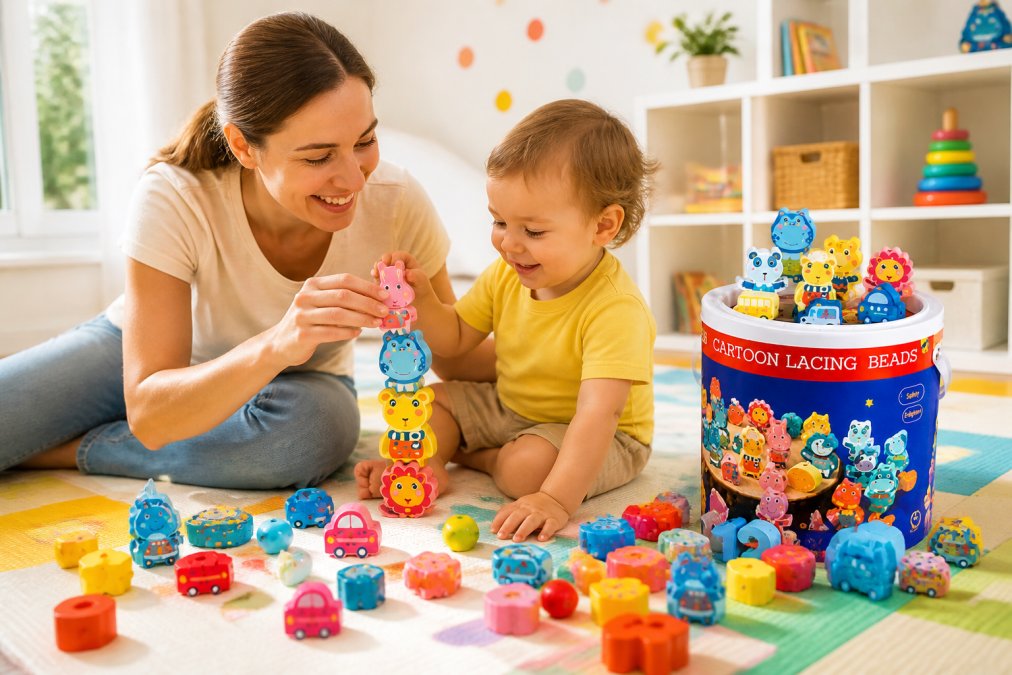
Create low-pressure exploration time. Not every play session needs to be directed or goal-oriented. Sometimes your toddler just needs time to explore materials without expectation. They might thread three beads and then switch to stacking. That's fine. The exploration itself is building skills.
Limit screen time. Fine motor development happens through hands-on exploration, not passive watching. The more time your toddler spends manipulating physical objects, the faster their fine motor skills develop.
Choosing Toys That Grow With Your Toddler
The most frustrating experience for parents is buying a toy that gets used for two weeks and then abandoned. The most valuable toys are ones that evolve as your child develops, offering new challenges and possibilities at each stage.
Look for toys with multiple entry points. The Lulliyotoys collection is designed around this principle. A threading bead set can be explored by an 18-month-old who's just learning to thread, and challenged by a three-year-old who's creating intentional patterns. A stacking toy can be stacked randomly by a younger toddler and balanced carefully by an older one.
Open-ended toys are more durable than single-purpose ones. A wooden block set can be stacked, sorted by colour, arranged in patterns, used for imaginative play, and later incorporated into more complex building projects. A toy that "does one thing" typically gets boring faster.
Consider the sensory experience. Toys made from natural materials, wood, cotton, felt, provide different tactile feedback than plastic. Some toddlers are drawn to smooth wood, others to textured fabric. Variety in materials keeps play interesting.
Check for safety certifications. Look for toys tested for non-toxic materials, especially for toddlers who still mouth objects. At Lulliyotoys, we prioritise premium quality materials and safety, ensuring every toy meets rigorous standards for young children.
Think about progression. A toy that's too advanced sits unused. A toy that's too simple gets boring. The sweet spot is something your toddler can engage with today and grow into over the next few months. Watch your child's interests and developmental stage, then choose toys that match where they are now, not where you wish they were.
Ask yourself: Will this toy still be interesting in six months? Can my child use it in different ways? Does it invite exploration without requiring instruction? If the answer to these is yes, it's probably a keeper.
Conclusion
Fine motor development isn't something you need to force or over-engineer. It happens naturally when your toddler has access to toys and materials that invite manipulation, exploration, and repetition. The toys you choose, whether premium Montessori-inspired pieces or household alternatives, matter less than the opportunity to practice.
At Lulliyotoys, we've built our collection around this understanding. Every toy is chosen to support fine motor skill development through purposeful play. From threading beads that build hand-eye coordination to stacking blocks that develop spatial awareness, our Montessori-inspired toys give your toddler the tools to explore, discover, and build genuine competence. Start with materials that match your child's current stage, follow their lead, and watch as their hands become more capable and confident. That's when you'll know you've chosen well.
Frequently Asked Questions
How can I tell if my toddler's fine motor skills are developing normally?
Fine motor development follows predictable patterns. By 18 months, toddlers typically stack 2-3 blocks and begin scribbling. At 2 years, they can turn pages, use a spoon with some spills, and stack 4-6 blocks. By 3 years, they copy circles, hold crayons with better control, and manage buttons. If your child shows significant delay in these milestones, such as difficulty grasping objects at 12 months or inability to stack blocks by 2 years, consult your health visitor or occupational therapist for guidance.
What's the best age to introduce fine motor skills toys to my toddler?
Start around 6-9 months when babies develop the pincer grasp and begin exploring objects with intention. At this age, soft stacking toys and textured sensory items are ideal. From 12-18 months, introduce threading beads, shape sorters, and simple puzzles. Between 18-36 months, offer more complex activities like balancing games and busy boards. Match toys to your child's current abilities rather than age alone, every toddler develops at their own pace.
Are expensive Montessori toys worth the investment compared to cheaper alternatives?
Quality Montessori toys are designed with developmental science in mind: they isolate specific skills, use natural materials for better tactile feedback, and encourage independent problem-solving. Premium wooden toys like the [136-Piece Wooden Lacing Beads set](https://lulliyotoys.com/products/136pc-wooden-lacing-beads-animal-alphabet-number) ($25.00) or the [Montessori Wooden Bear Shape Sorting & Stacking Toy](https://lulliyotoys.com/products/wooden-geometric-bear-shape-stacking-blocks) ($25.00) last through multiple children and maintain their appeal longer than plastic alternatives. They also reduce screen time and support deeper engagement. While not essential, investing in a few high-quality pieces often means less toy clutter and more genuine learning, addressing the common concern about toys ending up in the donation pile.
What household items can I use to practise fine motor skills if I don't have toys?
Everyday items work brilliantly for motor skill development: dried pasta shapes for threading, plastic containers with lids for opening and closing, wooden spoons for stacking, soft cloths for crumpling, and safe kitchen items like plastic cups for sorting. Muffin tins with different objects to sort, clothespins for clipping practice, and playdough for squeezing and rolling all build hand strength and dexterity. These DIY alternatives cost little and teach children that learning happens everywhere, not just with purchased toys.
This article was written using GrandRanker