

Sustainable Toys for Sensory Development: A Parent's Guide
Table of Contents
- Why Sustainable Toys Matter for Early Development
- Benefits of Wooden Sensory Toys for Growing Minds
- Non-Toxic Sensory Toys for Toddlers: What to Look For
- How to Choose Sensory Toys for Development
- Sensory Play and Fine Motor Skill Development
- Montessori-Inspired Sensory Toys That Last
- End-of-Life: Recycling and Disposing of Sensory Toys Responsibly
- Top Sustainable Sensory Toys for Babies and Toddlers
- Conclusion
Last Updated: August 26, 2026
Why Sustainable Toys Matter for Early Development
Sustainable toys for sensory development aren't just a trend, they're a deliberate choice that shapes how your child explores the world. When you place a wooden rattle in your baby's hand instead of plastic, you're offering something fundamentally different: a toy that engages multiple senses while respecting both your child's developing nervous system and the planet they'll inherit.
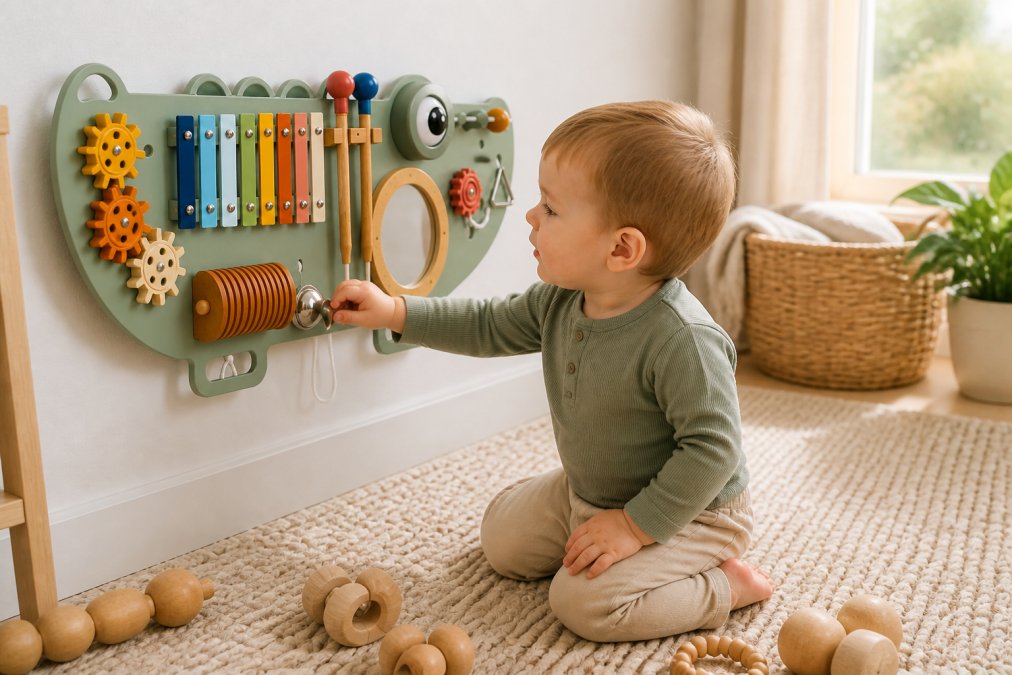
The connection between sensory play and early childhood development runs deeper than most parents realise. Babies and toddlers learn by touching, shaking, listening, and mouthing everything within reach (peer-reviewed research). Sustainable toys, made from natural rubber, organic cotton, and FSC-certified wood, provide tactile feedback that synthetic materials simply cannot replicate. That warmth of wood, the slight give of natural rubber, the softness of untreated fabric, these sensations matter during the critical window when your child's brain is wiring itself.
Beyond the sensory experience, sustainable toys tend to be designed with intentionality. They're built to last through multiple children, to be repaired rather than discarded, and to break down naturally when their life ends. This durability teaches an implicit lesson: things of value endure. Your child plays with a toy that will likely outlast their interest in it, and that object might eventually be passed to a sibling or cousin. That's profoundly different from the disposable toy cycle most families know.
The environmental argument matters too, but here's the honest part: it's not the main reason to choose sustainable toys for sensory development. The real reason is that they work better for your child's development. They're safer because they're made without the chemical coatings and dyes that leach into plastic. They're more engaging because they offer genuine sensory complexity. And they're more durable because they're built by people who expect them to survive real childhood.
Benefits of Wooden Sensory Toys for Growing Minds
Wooden sensory toys offer something that plastic simply cannot: authentic tactile feedback combined with developmental appropriateness. When your child grasps a wooden rattle, they're experiencing temperature, weight, and texture simultaneously, a multi-sensory experience that supports neural development in ways generic plastic toys don't.
The benefits break down into three clear areas. First, fine motor skill development. Wooden toys tend to have better weight distribution and ergonomic design for small hands. A wooden musical instrument set requires genuine grasping and manipulation, your toddler must adjust their grip, apply pressure, and coordinate both hands. This builds the hand-eye coordination and finger dexterity that eventually lead to writing, drawing, and self-feeding skills.
Second, sensory integration. Wooden toys provide consistent, predictable sensory input. Unlike plastic, which can feel cold and uniform, wood has natural variation. The grain, the subtle colour shifts, the slight imperfections, these details engage your child's developing sensory system more fully. This is especially important for children who struggle with sensory processing, as wood's natural properties tend to be calming rather than overstimulating.
Third, cognitive development through cause and effect. A wooden activity board with rotating cogs, sliding beads, and a xylophone teaches cause and effect through direct, immediate feedback. When your child taps the xylophone, sound happens instantly. When they turn a cog, it moves smoothly. This immediate, predictable response helps wire the neural pathways for understanding how the world works.
The Montessori approach, which emphasises self-directed learning through real, purposeful materials, aligns perfectly with wooden sensory toys. These toys don't do the work for your child; they invite your child to do the work. That's the distinction that matters for long-term cognitive development.
Non-Toxic Sensory Toys for Toddlers: What to Look For
Your toddler puts everything in their mouth. That's not a problem to solve, it's how they learn. But it means the toys they mouth need to be genuinely safe, not just labelled as such.
When evaluating non-toxic sensory toys for toddlers, look for specific markers rather than vague claims. First, check for certifications. FSC certification on wood means the timber comes from responsibly managed forests. GOTS (Global Organic Textile Standard) certification on fabric means the cotton was grown without synthetic pesticides and processed without harmful chemicals. These certifications matter because they're independently verified, a company can't simply claim them.

Second, examine the finishes. Water-based dyes and natural oils are the standard for quality sustainable toys. Ask whether the finish is food-safe, because if your toddler mouths it, it should be safe to ingest in small quantities. Avoid toys with plastic coatings, synthetic varnishes, or chemical treatments. The toy should feel natural under your fingers, no plastic sheen, no chemical smell.
Third, consider the construction. Toys should have no small parts that could detach and become choking hazards. Stitching on fabric toys should be tight and reinforced. Wooden pieces should be smooth with no splinters or rough edges. The toy should be designed so that it cannot be disassembled by a determined toddler.
Many parents worry about certifications because they feel like marketing language. The honest truth: they're your best protection. A toy from a reputable manufacturer that carries FSC and GOTS certifications has been tested and verified. That's not greenwashing, that's accountability.
How to Choose Sensory Toys for Development
Choosing the right sensory toys for development requires matching the toy to your child's current stage and your family's actual needs. This is where many parents go wrong, they buy based on what looks beautiful or what they think their child should like, rather than what will actually engage them.
Start with age-appropriateness, but interpret it broadly. A toy marked for 6+ months might work for your 4-month-old if they're advanced in motor skills, or might need to wait if they're still primarily mouthing. The key is matching the toy's complexity to your child's current capabilities. A toy that's too simple will bore them; a toy that's too complex will frustrate them.
Second, consider your child's sensory preferences. Some children crave tactile input and will spend twenty minutes exploring different textures. Others respond more to sound and movement. Observe what naturally draws your child's attention, then choose toys that amplify those preferences. If your child is mesmerised by the sound of rattles, invest in quality wooden musical instruments. If they love exploring textures, prioritise toys with varied surfaces.
Third, think about durability and versatility. Will this toy hold up through multiple children? Can it be easily cleaned? Will your child still be interested in it in six months, or will it become clutter? The best sustainable toys for sensory development are ones your child returns to repeatedly because they offer genuine engagement, not ones that look good on the shelf.
Finally, resist the urge to over-buy. A small collection of high-quality, intentionally chosen toys will engage your child more deeply than a large collection of mediocre ones. Rotation, putting some toys away and bringing others out, keeps interest high without requiring constant new purchases.
Sensory Play and Fine Motor Skill Development
The connection between sensory play and fine motor skill development is direct and measurable. When your child manipulates a toy, grasping, turning, sliding, shaking, they're strengthening the exact muscles and neural pathways needed for writing, drawing, and self-care skills later.
Fine motor skills develop through repetition and challenge. A toy that's too easy won't build new skills; a toy that's too difficult will cause frustration. The sweet spot is a toy that requires effort but is achievable. A wooden activity board with rotating cogs, sliding beads, and a xylophone hits this balance perfectly. Your toddler must coordinate both hands, apply varying amounts of pressure, and problem-solve how to make each element move.

Proprioceptive input, the sense of where your body is in space and how much force to apply, develops through play with toys that provide resistance. Wooden toys, which have real weight and solid construction, offer better proprioceptive feedback than lightweight plastic. When your child lifts a wooden toy, they feel its weight. When they push a wooden cog, they feel resistance. This sensory information is crucial for developing body awareness and motor control.
Open-ended play with sensory toys builds fine motor skills more effectively than toys with predetermined functions. A wooden rattle can be shaken, tapped, transferred between hands, or used to explore surfaces. Each variation requires slightly different motor control. A toy that only does one thing, like a button that plays a sound, offers less opportunity for skill-building.
The research on Montessori-inspired play consistently shows that children who engage in self-directed sensory exploration develop fine motor skills more rapidly than those given primarily passive entertainment (peer-reviewed research). The key is that your child is doing the work, not the toy.
Montessori-Inspired Sensory Toys That Last
Montessori philosophy rests on a simple principle: children learn through interaction with real, purposeful materials. A Montessori-inspired sensory toy isn't decorative; it's functional. It invites exploration. It teaches through direct experience rather than instruction.
The hallmark of Montessori-aligned toys is that they isolate a single concept or skill. A toy might focus entirely on cause and effect, or on colour discrimination, or on fine motor control. This isolation allows your child to master one thing deeply rather than juggling multiple features. A wooden musical instrument set, for example, focuses purely on sound production and hand-eye coordination. A sensory cloth book focuses on texture exploration and early visual learning. This clarity of purpose is what makes Montessori toys so effective.
Durability is built into the Montessori philosophy because these toys are meant to be used intensively and passed along. A well-made Montessori toy will survive years of daily play, multiple children, and still function perfectly. This isn't accidental, it's intentional design. Quality materials, solid construction, and timeless design mean the toy remains relevant and functional long after your child has moved on.
The Montessori approach also emphasises beauty. A beautiful toy invites interaction in a way a garish one doesn't. Natural wood finishes, soft colours, and elegant proportions appeal to children and adults alike. This isn't superficial, beauty signals quality and care, and children respond to that signal by engaging more deeply.
When choosing Montessori-inspired sensory toys, look for toys that do one thing well rather than toys that try to do everything. Look for toys made from natural materials with minimal decoration. Look for toys that will still be beautiful and functional in ten years. These criteria naturally point toward sustainable toys for sensory development because quality and sustainability are fundamentally aligned.
End-of-Life: Recycling and Disposing of Sensory Toys Responsibly
Most parents don't think about what happens to toys after their children outgrow them. But if you're choosing sustainable toys for sensory development, the end-of-life stage matters as much as the beginning.
Wooden toys that have reached the end of their useful life can be composted if they're made from untreated wood and natural finishes. Many local councils now accept untreated wood in garden waste streams. Check with your local waste management provider before composting, as requirements vary by region. If composting isn't available, untreated wooden toys can be donated to childcare centres, libraries with toy lending programs, or community organisations.
Fabric toys made from organic cotton can also be composted if they're free of synthetic materials and dyes. Remove any plastic components first, buttons, zippers, or plastic-based stitching, and compost only the fabric portion. Again, check with your local provider about what they accept.
The key is avoiding landfill when possible. A toy that took years to make and months or years to use shouldn't spend decades in landfill. Donation is always the first choice, passing a toy to another family extends its useful life dramatically. Online community groups, Buy Nothing networks, and local schools often welcome gently used toys.
If a toy is damaged but not beyond repair, consider repairing it. Wooden toys with loose joints can often be re-glued. Fabric toys with small tears can be stitched. This repair mindset, valuing the object enough to fix it rather than discard it, is central to sustainability. It's also the mindset Montessori education cultivates.
For toys that genuinely cannot be reused or repaired, research your local options. Some councils have specialist recycling programs for toys. Others have community repair cafes where volunteers help fix items. The goal is to keep the toy's materials in circulation rather than sending them to landfill.
Top Sustainable Sensory Toys for Babies and Toddlers
The best sustainable toys for sensory development are ones that combine genuine developmental benefit with environmental responsibility. Here's what actually works.
1. Wooden Baby Musical Instrument Set - Montessori Rattles (Lulliyotoys, $26.00)

This set of five wooden instruments, including rattles and shakers with built-in bells, hits the developmental sweet spot for babies aged 6 months and up. The smooth, warm wood is instantly appealing to little hands. The gentle rattle and shaker sounds stimulate hearing without being overstimulating. Each piece is designed for tiny hands to grasp, and the natural weight provides proprioceptive feedback that plastic rattles can't match.
What makes this set genuinely useful is that it isolates sound production as the primary learning goal. Your baby isn't distracted by lights, buttons, or screens, they're focused on the direct relationship between their action (shaking) and the result (sound). This is textbook Montessori design. The set costs less than many single plastic toys, yet offers more developmental value because each piece can be explored independently.
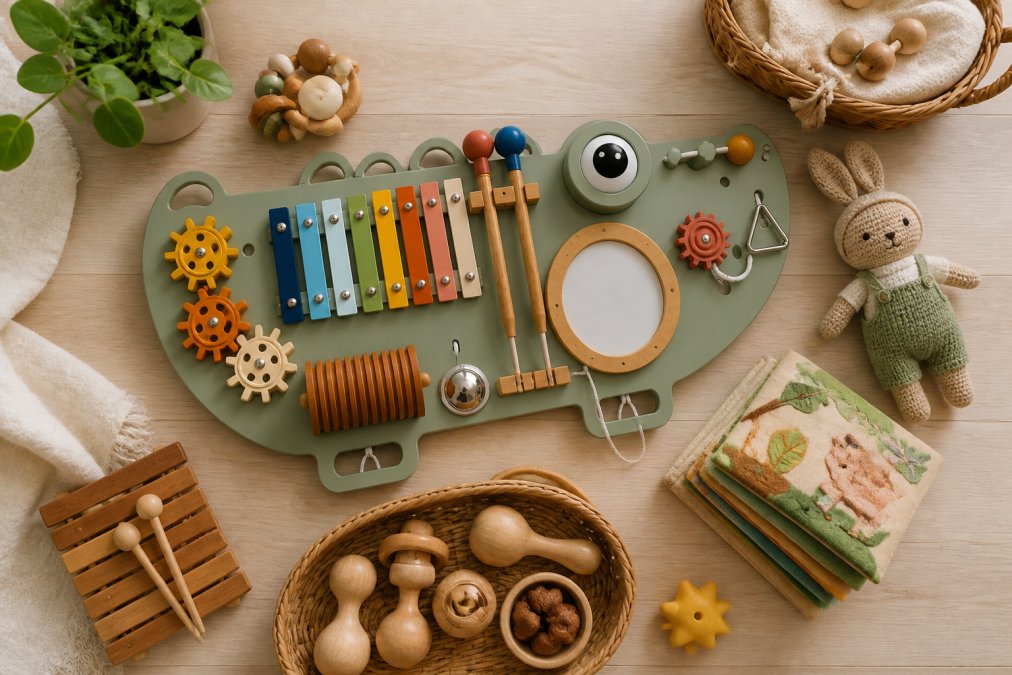
2. Crocodile Wall Activity Board - Musical Sensory Panel (Lulliyotoys, $79.00)
For toddlers ready for more complex play, this wall-mounted activity board combines multiple sensory challenges in one space-saving design. It includes a xylophone, rotating cogs, wooden rasp, mirror, sliding beads, and a shape maze. Each element targets different skills, hand-eye coordination, cause and effect, fine motor control, and spatial reasoning.
The genius of this design is that it's fixed to the wall, which means pieces don't disappear under the sofa. It's also designed for independent play, so your toddler can explore it for extended periods without needing your involvement. The natural wood construction means it will still look beautiful in a bedroom or playroom years from now.
3. Montessori Tummy Time Baby Pillow With Sensory Toys (Lulliyotoys, $45.00)
Tummy time is essential for developing neck and shoulder strength, but many babies resist it. This pillow changes that by making tummy time engaging rather than frustrating. The soft fabric pillow props your baby at the right angle for comfortable head lifting, while attached sensory elements, high-contrast details and interactive toys, give your baby something to reach toward.
The high-contrast patterns support visual development during the critical early months when babies are still learning to focus. The attached sensory elements encourage reaching and grasping, which builds the shoulder and arm strength needed for crawling. This is one of the few toys that serves a clear physical development purpose while also being genuinely engaging for your baby.
4. Baby Sensory Cloth Book Set - Soft Crinkle Learning Fun (Lulliyotoys, $37.00)
This set of four soft cloth books combines tactile exploration with early learning concepts. Each book features crinkle textures, playful animal tails, and simple themes introducing animals, colours, and everyday scenes. The tear-resistant polyester fabric stands up to the inevitable mouthing and rough handling that comes with babies and toddlers.
What distinguishes this set is that it's genuinely durable. Unlike paper books, which tear easily, these cloth books will survive years of play and can be easily washed. The crinkle sound provides auditory feedback, while the varied textures offer tactile exploration. For babies aged 3 months and up, this set offers sustained engagement without overstimulation.
5. Snail Suction Cup Spinner Toy - Sensory Travel Play (Lulliyotoys, $30.00)
This adorable spinner toy solves a real problem: keeping your baby engaged during car rides, restaurant visits, and other situations where you need portable entertainment. The rotating windmill design encourages visual tracking and grasping, while the suction cup base sticks securely to smooth surfaces.
The genius of this toy is its simplicity. There are no batteries, no screens, no overwhelming sensory input. Just a satisfying spinning motion that your baby can control by touching and turning. The soft, rubbery feel is pleasant to mouth, and the toy is designed to be easily cleaned. Parents report that this single toy has saved countless outings from becoming frustrating.
Conclusion
Choosing sustainable toys for sensory development isn't about perfection, it's about making intentional choices that serve your child's actual development while respecting the world they'll inherit. The toys you select during these early years shape not just their motor skills and sensory processing, but their understanding of quality, durability, and care.
At Lulliyotoys, we've built our entire collection around this principle: toys should be beautiful enough to treasure, durable enough to pass along, and developmentally purposeful enough to genuinely engage your child. Our Montessori-inspired designs, from the Wooden Baby Musical Instrument Set to the Crocodile Wall Activity Board, combine premium natural materials with intentional design to support the early development your child needs. Discover how the right toys can turn everyday play into genuine learning moments.
Frequently Asked Questions
Q: What makes sustainable toys better for sensory development than conventional plastic toys?
A: Sustainable toys often use natural materials like wood, organic cotton and natural rubber that provide richer tactile feedback and varied textures. These materials support fine motor skills and hand-eye coordination more effectively than smooth plastic. Natural finishes and water-based dyes also eliminate exposure to harmful chemicals, allowing babies to explore safely through touch, taste and sound without toxin concerns.
Q: Are non-toxic sensory toys for toddlers certified safe, and what should parents check?
A: Look for toys certified by recognised safety standards. Check product labels for certifications indicating non-toxic finishes, BPA-free materials and hypoallergenic construction. Reputable makers provide testing documentation and use food-grade finishes on items babies mouth. Ask manufacturers directly about their safety testing and material sourcing before purchasing, especially for toys your toddler will chew or mouth frequently.
Q: How do I know if a sensory toy will actually support my child's development, or is that just marketing?
A: Developmental benefits come from toys that encourage specific skills: fine motor tools require grasping and manipulation; sensory bins build hand-eye coordination; musical toys stimulate auditory processing and rhythm awareness. Choose toys aligned with your child's age and developmental stage. Montessori-inspired designs prioritise open-ended play and purposeful movement, which research supports for cognitive growth. Observe whether your child engages repeatedly with the toy, sustained engagement signals genuine developmental value.
Q: What's the best way to dispose of or recycle sensory toys when my child outgrows them?
A: Wooden toys can often be composted if untreated or donated if in good condition. Check with your local council's waste management guidelines for accepted materials. Cloth and fabric toys may be recycled through textile collection schemes. Plastic components should go to plastic recycling where accepted. Before disposal, consider passing toys to younger siblings, friends or local childcare centres. Many charities accept gently used educational toys, extending their life and reducing landfill impact.
This article was written using GrandRanker